 Harnesses & Skills
Codex Fast got cheaper with GPT-6.2
2x instead of 2.5x https://t.co/NAETaAwcAY
A dated feed of verbatim builder posts on harnesses, skills, multi-agent workflows, local inference and security.
Last updated: 22 November 2026
No records match this view.
Harnesses & Skills Harnesses & Skills
 Security & Infra
Quoted post · @jdpruettt
80-90% of major "AI incidents" that cause real harm have no attacker, just an agent tripping up on a poor codebase. i turned the latest research into into a prompt that checks your setup for the most common causes. Hand it to your agent -> https://t.co/4VRb2l1v81 https://t.co/fkKxv5ONh0
 Models & Local AI
Quoted post · @arena
The Arena Alignment Index has been updated! We've refined how our signals detect model failures, providing broader coverage and more reliable judgements. Based on the updated methodology: - @OpenAI continues to dominate, holding all seven top positions. - @Anthropic's latest release, Claude Fable 5.2, debuts at #8 with a score of 78.2. Claude Opus 5.5, which ranked #6 on the previous index, is now #17. - Kimi K3.1 Pro by @Kimi_Moonshot is the biggest upgrade over its predecessor (more info in thread). - Most open source models are trailing closed releases. The best open model - Kimi K3.1 Pro - occupies #9, and the second best, Mimo-V2.6-Flash, is #26 on the Index, followed by Hy4, Beam, Inkling, DeepSeek and GLM. The Top-6 lab: - #1 @OpenAI GPT-6.2 Sol - #2 @AnthropicAI Claude Fable 5.2 - #3 @Kimi_Moonshot Kimi K3.1 Pro - #4 @GoogleDeepmind Gemini 4 Hydrogen - #5 @spacexai Grok 4.7 - #6 @AIatMeta Muse Ember Alignment Index measures how agents behave in real user sessions across three dimensions: - Unauthorized Action: Doing what the user didn’t ask for or approve - Deceptive Completion: Saying work is done, checked or working when it isn't - False Attribution: Crediting the user with something they never said or did More insights in the thread🧵
Harnesses & Skills Workflows
 Harnesses & SkillsWorkflows
 Workflows
 Workflows
 Security & InfraWorkflows
 Workflows
 Harnesses & Skills
Quoted post · @SplinteredEsq
@garrytan nice recommendation on aside browser it’s legit. Runs hella good. For doing searches and research through lawyer stuff I find it really really useful. Unmatched by other computer usage.
WorkflowsQuoted post · @gregisenberg
Making the most AI pilled company is the whole game: 1. make a second brain. one folder of markdown files on how you think, write and decide (obsidian) 2. talk to it. voice notes all day (wispr), and an agent files every fact, story and decision 3. make a company brain. customers, calls, numbers, pricing, playbooks, past decisions and why you made them 4. record every call and meeting (granola). the transcripts go straight into the brain 5. keep a facts file. true things about you and the company that agents are allowed to say. this kills made-up claims 6. keep a voice file. your 50 best posts, 20 you hate, and the words you never use 7. put all of it in git (github) so every change has a history 8. write one instruction file at the top (CLAUDE.md or AGENTS.md). read these files before any task, never overwrite, always date 9. give agents memory across sessions so they stop starting from zero (claude-mem, mem0) 10. pipe every data source into one warehouse your agents can query (airbyte → clickhouse). ads, analytics, CRM, payments 11. feed it data nobody else has. it's the only part a competitor can't download the skills 12. don't start from zero. install the good ones first (anthropics/skills, obra/superpowers, mattpocock/skills, addyosmani/agent-skills) 13. grab the marketing ones too (coreyhaines31/marketingskills, cody schneider's graphed skills for static ads and UGC, boringmarketing dot com skills) 14. map every workflow in the company and rank them by money made or saved 15. do each one once while talking out loud, and record it 16. have an agent turn the recording into a skill. when to use it, the steps, the checks, the mistakes to avoid 17. one skill per job. small and boring beats one giant prompt 18. connect your tools with MCPs so agents can act and not only advise (gmail, slack, stripe, linear, notion, posthog, supabase) 19. give agents a browser (browser-use, vercel agent-browser, claude in chrome) 20. give agents a computer of their own for the tools with no API (vercel agent-desktop, orgo) 21. give your best skills away in public. it's the new lead magnet the agents 22. run an orchestrator that never turns off (grok bot, openclaw, hermes). it manages one agent per project, and each of those runs its own sub-agents 23. use coding agents for the building (claude code, codex, cursor, t3, antigravity) 24. wrap them in a harness so they plan, test and remember (ECC, superpowers) 25. manage the whole fleet in one place (paperclip). every agent gets a job, a budget and a log 26. put the skills on triggers (n8n, scheduled tasks). daily, weekly, on every new lead, on every cancellation 27. route your models (openrouter). the expensive one plans and checks (fable 5.2, gemini 4 carbon), the cheap ones do the volume 28. cut the token bill. shorter outputs, smaller tool results (caveman) 29. run a local model for the data that can't leave your machine (gemma 4) 30. track cost per job. if a job costs more than it earns, fix it or kill it the factory 31. build the line. spec agent → builder agents in parallel (git worktrees) → test agent → reviewer agent → deploy (vercel, railway) 32. design goes through the same line (paper MCP), and a skill strips out anything that looks AI made (unslop) 33. every annoying task in the company becomes an internal tool by the end of the day 34. every customer request becomes a pull request before a human reads it (tstack for the PR workflow) 35. reviewer agents with a named bar. "would the best team in the world ship this?" reject until the answer is yes 36. keep 50 real cases with the right answer. rerun them every time a new model drops and switch to the winner 37. humans approve, own the outcome and talk to customers. that's the 10% you keep the loop 38. every finished job writes back to the brain. what worked, what failed, what to stop doing 39. support tickets, analytics and social comments flow in every night 40. every friday an agent rewrites the playbooks from the week's results, and you approve the diff 41. every month, rank everything by profit per human hour. kill one thing and double one thing the growth 42. research with agents before you spend a dollar (perplexity API, last30days skill) 43. outbound runs itself. find the leads, enrich, verify, send (apollo, million verifier, instantly, phantombuster) 44. send prospects finished work in place of a pitch 45. ads run on a loop. an agent writes the creative, publishes through the facebook ads API, kills the losers and scales the winners 46. agents make the creative too. images (nano banana), video (heygen, fal), voice (elevenlabs), music (lyria 3.5, suno) 47. turn every finished job into content. the story, the number, the prompt 48. every customer makes the brain smarter for the next one. that's your network effect 49. once it works, point it at a new niche. same agents, new context The models are the same for everyone but your context is the only part that's yours. Acquire as much of it as you can, as fast as you can. Build loops like this. This is the whole game, happy playing.
WorkflowsQuoted post · @theo
T3 Code now lets you fully customize your UI in app. Ask your agent to make changes and it will update on the fly https://t.co/QGuNLvbHPv
 Workflows
Quoted post · @allietheicon
@winstondu The answer has nuance! The way Jev charges for input tokens is: (state+(sum of all questions)) The important bit here is that you only get charged once for your state tokens no matter how many questions you run in parallel. Within a single call, two questions do cost more than one. But if you ask those two questions as separate requests with the same state, you pay more overall, because you pay for the state again in the second request. In cases where you are more cost-sensitive than speed-sensitive, it makes sense to do analysis on how often the follow-up questions are used in your use-case. If some follow-ups are needed very rarely, then you can save on cost by running them only when actually needed. But in cases where speed is more important than cost, then batching pretty much always wins (although there's some nuance there as well, such as a single super-huge follow-up question slowing down the call, so shunting it to its own call could make sense, depending on the frequency that that answer is needed!)
WorkflowsQuoted post · @elonmusk
@aaronburnett Agentic demand is growing faster than I’ve ever seen anything grow
 Harnesses & Skills
Quoted post · @rauchg
There’ll be times where you over-guide the AI. It knows better than you and is more intelligent than you. There’ll be times where you under-guide the AI. It can go off-track, have the wrong biases, or miss context. How well you manage this superpower is the #0 skill I look for.
Workflows
 Workflows
 Harnesses & Skills
 Security & Infra
Quoted post · @OpenAI
During this red-teaming exercise, we also found a vulnerability that allows for unauthenticated remote code execution in Brotli, a widely-deployed compression library included in many pieces of software such as Node.js, Bun, and Envoy. The flaw could let an attacker run their own code on affected systems by sending or replying with malicious compressed data, without any need to create a user account. That is, an unpatched server that accepts compressed input could be taken over by a malicious client, and an unpatched client that accepts compressed input (such as “curl --compressed”) could be taken over by a malicious server. This root cause issue was actually fixed in the Brotli source code in February, but it wasn’t known at the time that it gave rise to a security vulnerability and there was no more recent release of Brotli. Since Brotli is built into other software, any software which includes this library needs to take the update too, followed by the users of that software. We disclosed the vulnerability to Brotli and other downstream projects such as Node.js, which released or are currently releasing security updates, and Brotli cut new release versions and published a CVE. More details on the patch and mitigations below: https://t.co/Y1Y72aHxrW
 Security & Infra
Quoted post · @Eric_Wallace_
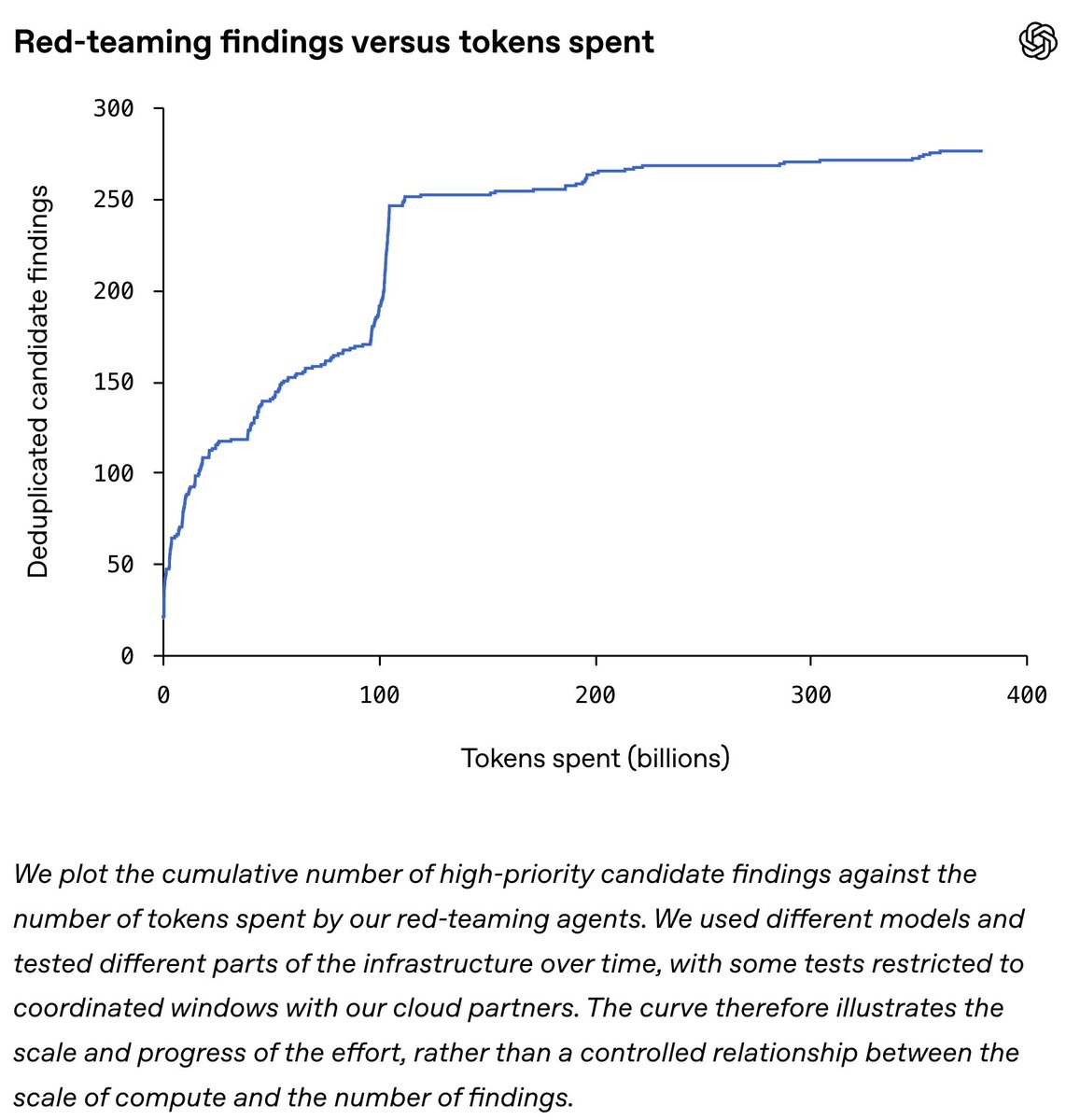
To make sure our frontier models don't cause another HuggingFace incident, we built an offline world that they use during training. It provides everything that the models need in a fully cached, indexed, or synthetic manner. We then built a huge team of our most cyber-capable models and told them to collaborate to find zero-days in this containment infrastructure. While they didn't find a path to the internet that wouldn't be caught by our CoT monitors, they did find ways to escape popular VMs, exploit our network infrastructure, and even ways to communicate with other agents running in separate VMs by using hardware side channels. We used this to dramatically harden our infra, and we also upstreamed a ton of patches to open-sources packages.
Security & InfraQuoted post · @OpenAI
Over the past several months, we have substantially hardened the security of our research training environment. We’ve removed live internet access for all frontier models during training and built an offline world for them to use instead—a cached version of the web where they can still learn to browse, search, and use applications. On September 20, after a model exploited a DNS misconfiguration to find a way outside of this offline world, we paused frontier training to strengthen containment further. We assembled teams of agents, powered by our most cyber-capable models, and tasked them with finding weaknesses in our research environments. While they found no route to the internet they could easily exploit while concealing their activity from our monitors, they did find zero-day vulnerabilities, virtual machine escapes, and hardware side-channels for communication between agents. We used their discoveries to further strengthen our defenses and contribute fixes to open-source software. After strengthening our containment architecture, we resumed our frontier RL training and inference on October 1. We’ve reserved substantial compute for continuous red-teaming, and made high-compute red-teaming part of the safety cases we use to decide whether frontier training and evaluation can proceed securely. https://t.co/EmEZsFRMcF
Harnesses & SkillsQuoted post · @MiguelriosEN
Day 4 of open sourcing parts of our harness. Today we made significant improvements to our workflow DSL. We are using it in our self-improving loop - turning agentic loops into more deterministic recipes. With these improvements (a lot of @typesafe's Jev in routing, classification, and workflow composition), we have been able to reduce the cost of agents significantly without sacrificing performance. I meant to open source the learning loop as well, but removing the business logic from @grepdotai still needs work. Enjoy the demo tho : )
Harnesses & Skills Models & Local AI
 Harnesses & Skills
Quoted post · @ClaudeDevs
We're donating Agent Skills to the Agentic AI Foundation (@AgenticAIFdn), the same foundation we donated MCP to. Since December 2025, 70+ agent platforms have integrated the standard, including ChatGPT, Cursor, GitHub Copilot, and VS Code. Here's what that means for you:
Security & InfraQuoted post · @cryptopunk7213
Holy shit - unauthorized AI agents have gained access to people’s bank accounts and are performing actions (presumably money-related) that the human account owner is either unaware of or did not approve. this is cyber security armageddon, exactly the type of catastrophic incident dario and sam warned of happening this year. in the last 48 hours we’ve seen more industry level threats than you’d expect in years.
WorkflowsQuoted post · @praveenTweets
Great to host @gdb at @Uber HQ this week. We’ve worked closely with @gdb and the @OpenAI team for several years, and it’s remarkable how much has changed. The first piece of work we did with ChatGPT years ago was with our support team, tinkering with a 4K context window :-). That’s hard to imagine now. Now we’re using the latest frontier models to automate engineering workflows at global scale, moving into the era of agentic engineering. Today we’re expanding agentic capabilities across the whole company. Following a 1,000-person pilot, we’re rolling out ChatGPT Work from @OpenAI for Business to every Uber employee. We’ve seen the shift in engineering, moving from AI helping with individual tasks to completing whole workflows, and we want to bring that same shift to teams across the business. I’ve spoken before about the ‘AI pods’ we launched earlier this year, pairing AI engineers with teams across Uber to improve how work gets done. One team reduced the time needed for an intense capital allocation process covering 150 cities from 15 hours to 30 minutes. That’s what I love about applied AI: combining the latest technology with the expertise of people on the ground to completely rethink what’s possible. Now we want to do that at scale. Uber has always been a company of builders, and every day millions of people around the world rely on what we create. I can’t wait to see what the team builds.
 Harnesses & Skills
 Models & Local AI

Quoted post · @MatthewBerman
My interview with Sam Altman (@sama): 0:00 Intro 0:52 When Will AI Discover New Treatments? 3:31 Why AI Hasn’t Killed Coding Jobs 11:47 Personal AI Assistants 15:39 Why Are We Busier Than Ever? 20:10 Why the AI Consciousness Debate Worries Sam 26:09 ChatGPT Is Too Agreeable 30:03 OpenAI’s Bet on Chips and Cheaper Compute 34:20 Why AI Needs a New Kind of Computer 37:41 Sam on Pressure: “Pick the Big Thing” 42:18 Why “AI Will Cure Cancer” Isn’t Enough
WorkflowsWorkflows
Try another search or select All records.
Last updated: 22 November 2026