Key takeaways from posts, podcasts and presentations by Jensen Huang.
Last update: 26 October 2026
Choose a topic
Choose a subtopic
70 records
No records match this view.
A free chip can still produce a more expensive token
It is very likely that the $50 billion factory, and in fact, I can prove it that the $50 billion factory will generate for you the lowest cost tokens.
Jensen Huang · ALLIN · 7:33Source: All-In, 7:33–8:33; GTC Berlin, 27:17–28:13. The equipment split, rival costs, free-silicon case and revenue scaling are analyst calculations. The talks describe different dates and systems.
At 10× throughput, a $50bn factory has a lower capital cost per token than a $30bn rival factory. The result depends on useful output per watt.
Test the throughput assumption
Rival capital cost per token Nvidia = 1.00×
Nvidia throughput needed to break even
Rival factory capex within the 1 GW envelope
Rival capex = $30bn fixed equipment + $20bn silicon × (1 − discount). Relative capital cost per token = rival capex ÷ $50bn × Nvidia throughput. Equal useful life and utilisation; operating costs and financing are excluded.
Read the scenario data and assumptions
Illustrative 1 GW comparison. Baseline figures stay fixed when the controls change.
Scenario
Capex
Throughput
Token cost¹
Revenue²
Nvidia full stack
$50bn
10.0×
1.0×
~$40bn/yr
Half-price rival silicon
$40bn
1.0×
8.0×
~$4bn/yr
Free rival silicon
$30bn
1.0×
6.0×
~$4bn/yr
¹ Capital-cost proxy. The inferred split is $20bn land/power/shell, $10bn other equipment and $20bn silicon. ² Illustrative revenue capacity combines Berlin's ~$40bn/yr claim with All-In's 10× comparison and assumes equal realised revenue per output. It gives a derived ~$36bn/yr capacity gap. It measures capacity, rather than booked revenue or profit.
Read the transcript excerpts 9 passages
Factory cost and token cost · Jensen Huang
It is very likely that the $50 billion factory, and in fact, I can prove it that the $50 billion factory will generate for you the lowest cost tokens.
The difference between that GPU being 1x price or halfx price is not between 50 billion and 30 billion. Pick your favorite number, but let's say between 50 billion and 40 billion.
ALLIN · 8:13Throughput and free silicon · Jensen Huang
That is not a large percentage when the $50 billion data center is actually 10 times the throughput, right? Jess, that's the reason why I said that even for most chips, if you can't keep up with the state of the technology and the pace that we're running, even when the chips are free, it's not cheap enough.
And so we just said it's $40 billion per year of revenue generation that comes out of that infrastructure. $40 billion if delayed by just 3 months, that's $5 billion, excuse me, what is that? $10 billion worth of revenues. $10 billion worth of revenues will make anybody anxious.
BERLIN · 27:48Installation to first token · Jensen Huang
And so by moving this into the supply chain, the speed by which we can turn on, go from installation, arrival of computing to production of tokens will go from many months, we think something along the lines of 4 to 5 months down to about a month.
Blackwell was about 30 times faster than Hopper in doing a genetic in doing large language model processing. And now, Vera Rubin is another 30 times greater than Blackwell in just 2 years time. Let's take a look at how Vera Rubin turns into what is a DSX full stack AI factory.
Power leaves 10 to 15 GW of announced chips waiting
Energy powers advanced computers that are part of an AI factory that generates tokens, digital intelligence from the models that run on it that are integrated into every application.
Jensen Huang · BERLIN · 3:47Source: Brad Gerstner, BG2, 51:44, for the 50 GW and 35–40 GW estimates; Huang, 1:02:44–1:05:45, for the business segments. Flow widths are proportional to the illustrative GW values.
Brad Gerstner cites about 50 GW of announced silicon against 35 to 40 GW of possible online capacity. Huang describes demand across three broad groups.
The 12 / 11 / 12 GW allocation is an analyst illustration, rather than measured industry demand. Huang cites about a third of Nvidia's business for baseline computing, 25–30% for frontier labs and about a third for startup cloud demand. The illustrated lab share is 31%. At 40 GW online, 10 GW would be deferred. Timing of that backlog remains unspecified.
Read the flow data and context
50 GW announced = 35 GW online + 15 GW deferred in the drawn case.
35–40 GW × the illustrative $50bn/GW factory cost implies $1.75tn–$2tn of capex across statements from different talks.
Huang's 80% infrastructure revenue share does not establish a physical capacity share.
Enterprise licensing at a couple of thousand dollars per GPU per year is simple maths in the conversation. The telco prediction of 100,000 sites and about 100 GW is long-term and separate from this 2027 flow.
Read the transcript excerpts 11 passages
Announced chips and power range · Brad Gerstner
And I guess what I what I what I hear from the street is there's this idea that you know maybe there's 50 gawatts of announced chips um that are underway um or talked about and maybe 35 to 40 gawatts of compute or land power shell that might come online. So what compute fits into that land power and shell and on what timeline is a question up in the air. Yeah.
Energy powers advanced computers that are part of an AI factory that generates tokens, digital intelligence from the models that run on it that are integrated into every application.
BERLIN · 3:47Power constraint · GTC Berlin DSX video narrator
So when people are looking at 80 Nvidia and and we now run the infrastructure of the world and I just said 25% of it maybe 30% of it is the Frontier Labs, right?
Right? And so so long as I can prove that our performance is extraordinary and we prove that every single day, the moment we can prove that then fungeability and durability translates to rentability which translates to productivity and financeability and therefore financeability which leads to the lowest TCO.
And so, you know, if if our software license is, you know, just roughly say for for for simple math, a couple of thousand dollars per GPU per year and we have millions of GPUs, right? We have we we ship, you know, 20 million GPUs say a year. I'm growing and so half of it goes into world's enterprise. It adds up.
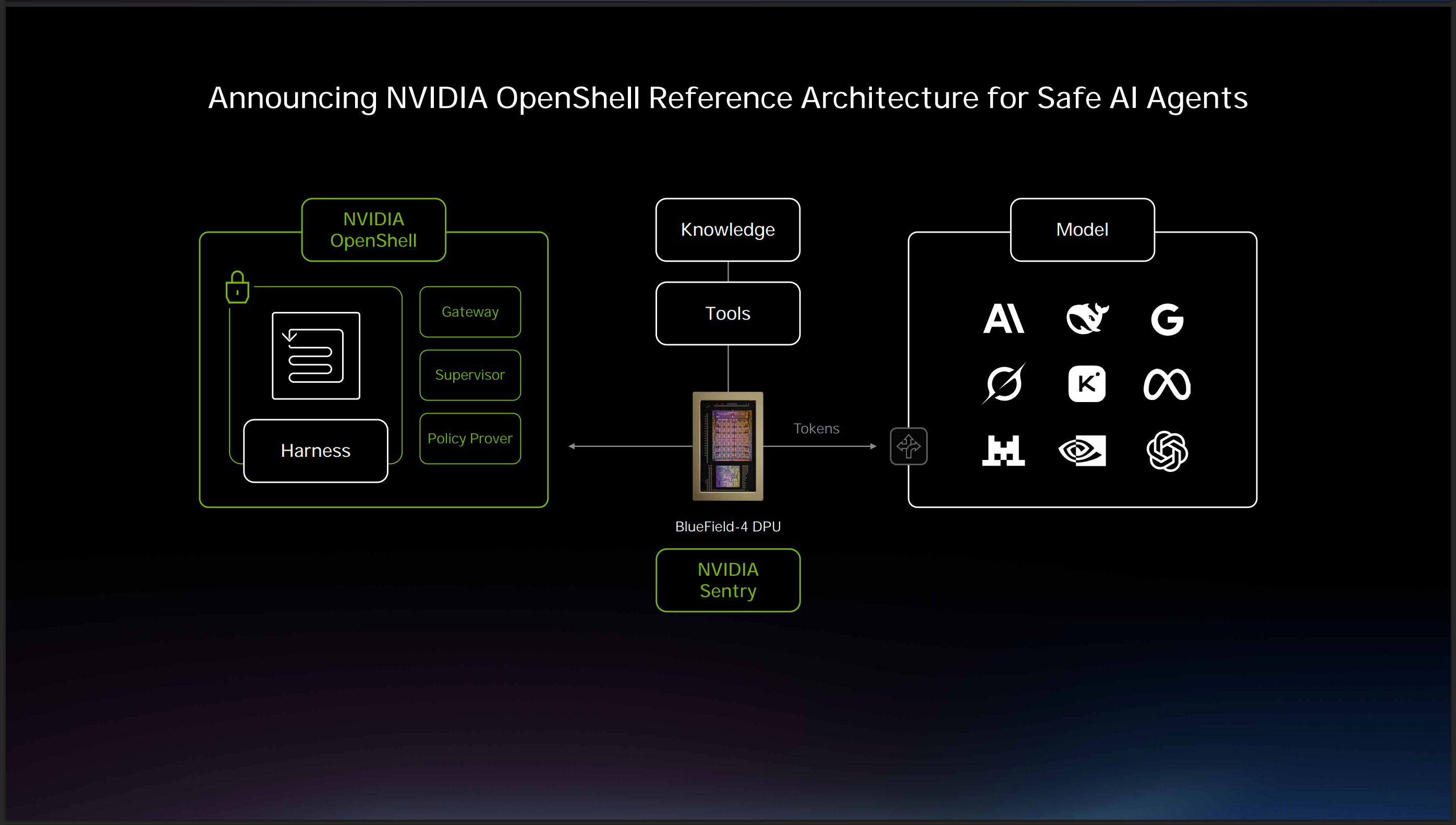
Models, sandbox, harness, knowledge and tools. These are the five elements of an agent.
Jensen Huang · BERLIN · 36:15Source: NVIDIA GTC 2026 presentation. Select the original slide to open the full-resolution image.
The harness coordinates the work. OpenShell governs access outside the agent. Optional Sentry monitoring adds a separate hardware trust domain.
The 2-of-3 policy covers sensitive data, code execution and external communication. It is a principle from All-In. The diagram makes no claim that every OpenShell installation enforces it automatically. The security video claims millisecond quarantine and tamper-evident records; independent security performance remains unverified.
Read the transcript excerpts 10 passages
The exoskeleton · Jensen Huang
Basically, this exoskeleton of the digital agent. Just as we have the brain, the rest of our body represents our exoskeleton, the agent is the exoskeleton that orchestrates the work that allows the agent to actually engage memory, active memory, working memory, as well as long-term memory, and activating tools. Then the third part is a computer that processes knowledge, designed for data processing. And then lastly, a computer dedicated to CUDA X libraries.
Now of course one of the things that we had to help it do is whenever you have agentic software you have to make sure that and agentic software has access to sensitive information. It execute code. It could communicate externally. We have to make sure that all of it has to be governed.
all of it has to be secure and that we have policies that that gives these agents two of the three things but not all three things at the same time
ALLIN · 16:16Security engineering · GTC Berlin security video narrator
Safety isn't an aspiration. It's technology and engineering.
BERLIN · 37:29External credentials · GTC Berlin security video narrator
Keys stay outside [music] with the supervisor and are added only on the way to an approved endpoint. A compromised [music] agent can't leak a key it never had. The gateway is the control plane. The supervisor makes the [music] decisions. The sandbox holds the agent. And the policy prover checks proposed policies against [music] your permission settings. Open Shell combines Linux kernel isolation with runtime policy enforcement.
BERLIN · 38:59Hardware-isolated monitoring · GTC Berlin security video narrator
Nvidia Sentry adds an optional layer of protection outside [music] the host itself, away from the agent. Running on Nvidia BlueField 4, Sentry [music] monitors agent activity and enforces security policies in a hardware isolated trust domain. Because agent reasoning traffic passes [music] through Sentry, if the agent is planning to do something unintended, it will update policies immediately and cut the connection to the [music] model, quarantining it in milliseconds.
BERLIN · 39:26Audit records · GTC Berlin security video narrator
And it keeps tamper-evident records [music] that operators can verify for detection, investigation, and response.
And so so the the the monitoring has to be out of band and it has to have the ability to observe that the autonomous system is doing something that was inconsistent with the policy or inconsistent with alignment. And you have the ability to either escalate or shut it down, right?
AI is here, there'll be more users of these tools that we created over time than ever before. Every single tools company will now become an AI company.
On top of this, Remember, uh, Moore's law is over, right? There was a time if you want to get twice as many transistors, you just wait one year, right? And if you want twice as many transistor, get another wait one year. Same price. But if you want twice as many transistors now, doesn't matter how long you wait, you have to pay twice as much. Okay? Because Moore's law is over. And so whatever whatever computing capacity that the world wants, every single year, if you want twice as much, you're going to pay twice as much.
Moore's Law is dead. Between Hopper and Blackwell, from the transistors themselves, call it 75%.
Jensen Huang · Dwarkesh · 1:32:32GTC Berlin, 11:21–12:07. Claimed AI performance gains and a hypothetical Moore's Law comparison. Scale is logarithmic; intermediate years are omitted.
Huang compares a million-fold AI performance gain over ten years with a hypothetical 100-fold gain from Moore's Law.
~25%/yrMoore's Law paceDwarkesh, 22:00. A separate annual comparison.
+75%Transistor contributionHopper to Blackwell, three years. Dwarkesh, 1:32:32–1:32:40.
$5bn → $50bnCapital per GWGeneral-purpose compute to the Vera Rubin example. BG2, 1:10:59–1:11:06.
The 10,000× performance ratio and 10× capital-intensity ratio are calculations. Each uses a different comparison. The talks provide no common workload benchmark or constant-price cost-per-token series.
Read the verified transcript excerpts
Jensen Huang · Dwarkesh
Moore's Law is dead. Between Hopper and Blackwell, from the transistors themselves, call it 75%.
On top of this, Remember, uh, Moore's law is over, right? There was a time if you want to get twice as many transistors, you just wait one year, right? And if you want twice as many transistor, get another wait one year. Same price. But if you want twice as many transistors now, doesn't matter how long you wait, you have to pay twice as much. Okay? Because Moore's law is over. And so whatever whatever computing capacity that the world wants, every single year, if you want twice as much, you're going to pay twice as much.
A token allowance becomes part of the labour budget
The job of a radiologist is patient care. The task is to read a scan.
Jensen Huang · Dwarkesh · 1:29:14Dwarkesh, 1:29:14; All-In March, 24:28–24:37; GTC San Jose, 2:03:39–2:03:51. The cost strip follows the controls below.
Huang proposes giving an engineer tokens worth half their base pay, with a ten-fold increase in useful output as the ambition.
Test a team's annual token budget
Annual team token budget
Annual salary plus tokens
Cost per output unit at 10× output
Tokens = team × salary × allowance. Cost per output unit = (1 + allowance) ÷ 10, relative to salary alone. The 10× output case assumes equal quality and fully useful work. Review and integration costs are excluded.
$50tn × 20% = $10tn. Brad Gerstner's BG2 scenario assumes a total 20% gain in knowledge-work productivity over five years, by 2029/2030. The $10tn is additional annual output at that endpoint. It is a conditional scenario.
Read the verified transcript excerpts
Jensen Huang · Dwarkesh
The job of a radiologist is patient care. The task is to read a scan.
Open models broaden the argument for compute demand
and and the way I think about closed closed closed models is kind of like bottled water.
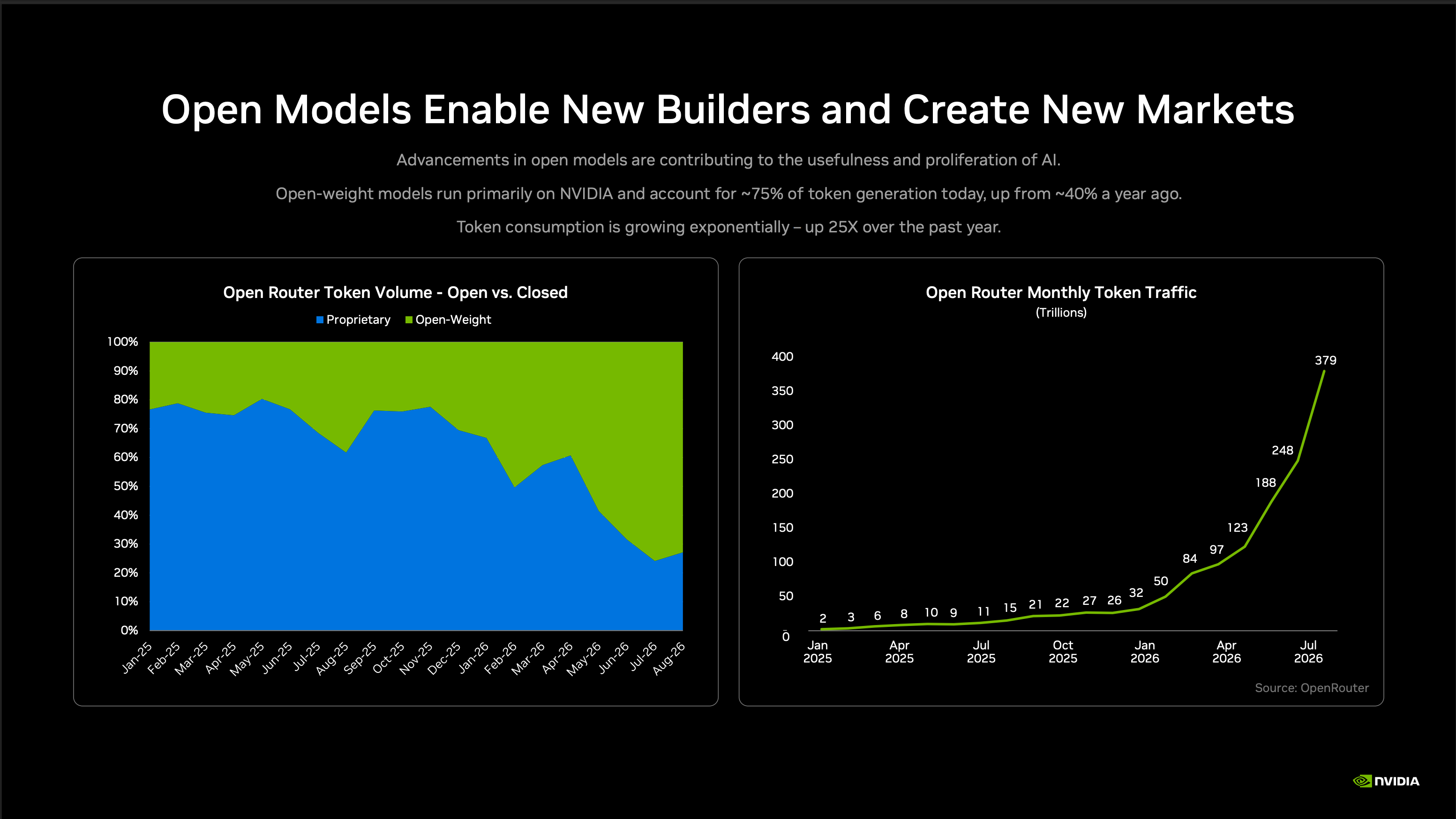
Jensen Huang · All-In September · untimed transcript, lines 493–495NVIDIA slide #36, attributed there to OpenRouter. Values are transcribed from the supplied PNG, in trillions. Point order is preserved. The final point's month is ambiguous: the last printed tick is July 2026, with one further point. The slide's 25× annual-growth headline uses a different period and is excluded here. Raw OpenRouter data remains unverified.
Huang's bottled-water analogy allows both closed and open models. The supplied slide shows rapid token growth on OpenRouter.
1999Dark-fibre analogyTest idle capacity and financing exposure. Historical baseline needs a primary source.
2026Compute demand testMeasure utilisation, rental prices, workload mix and useful life. BG2, 1:23:15–1:24:24.
The inherited claim of 100% utilisation for six-year-old A100s, with rising spot prices, remains unverified at the cited transcript anchors. It is withheld from the quantitative comparison. The local seed contains a separate Huang post claiming a 2020–2029 mission-capable life.
OpenRouter's plotted mix is specific to that source. "Tap water" is an editorial label for Huang's free-water analogy. The All-In September transcript is untimed, so its excerpt carries a line reference.
Read the verified transcript excerpts
Brad Gerstner · BG2
A year ago, we were sitting here and the consensus forecast was that you were going to be flat or shrink in 2027. Now the consensus forecast you're going to grow 74%.
Quotes below each exhibit are exact, contiguous excerpts from the local primary transcripts. Repetitions, transcription errors and bracketed stage cues remain. The Berlin security passages belong to a narrated video introduced by Huang. The excerpts have been checked against the text, with no independent audio review.
The source-audited Markdown dossier is the canonical research record. This local prototype has no publication or deployment approval.
Sources: All-In at GTC, 20 March 2026 · BG2, 15 October 2026 · GTC Berlin, 21 October 2026.
I was the opening act for a family of ducks.
Thank you, Berlin. What a GTC.
Europe is building its AI ecosystem and economy, from AI factories to agents to robots.
DSX POD: Vera Rubin modular factories built, cabled and tested in the factory, then delivered ready to produce intelligence.
Agents: models, harnesses, sandboxes, knowledge and tools. NVIDIA Agent Toolkit brings the pieces together so companies control what their agents know, access and do. NVIDIA OpenShell enhances safety.
Physical AI: new customers across AI-RAN, robotaxis and robotics.
Personal AI: after four years building with Microsoft, RTX Spark brings personal agents to the Windows PC.
Thank you to President @EmmanuelMacron, Prime Minister @andyburnham and Chancellor @bundeskanzler for hosting me. Great to celebrate Sferical One with Sweden’s technology leaders. And thank you to President @TokayevKZ for the warm welcome.
And to our partners and NVIDIA teams: thank you for making it happen.
The keynote is here: https://youtu.be/rF1EsryCAwc
Think of AI as a five-layer cake. Energy powers advanced computers that are part of an AI factory that generates tokens, digital intelligence, from the models that run on it that are integrated into every application.
GTC Berlin 2026, Jensen Huang keynote, 21 October 2026.
In the course of that last 10 years, we've improved AI performance by 1 million times. What would Moore's Law have done in 10 years? The first 5 years a factor of 10, the second 5 years another factor of 10. 100x. Because of extreme co-design, we're able to accelerate AI by a million times.
GTC Berlin 2026, Jensen Huang keynote, 21 October 2026.
With Vera Rubin, we're extending it beyond large language models, to processing the entire agent. The agent has to think, and that's where the model comes in: perception, reasoning, planning, and using tools. The agent also has a harness. Then a computer that processes knowledge, and a computer dedicated to CUDA-X libraries whose job is to run tools. These computers represent the entire agentic system.
GTC Berlin 2026, Jensen Huang keynote, 21 October 2026.
We call it DSX Pod. By moving this into the supply chain, the idle computing sitting inside your data centers reduces dramatically. Each gigawatt data center is $50 billion. $40 billion a year of revenue, delayed by just 3 months, is $10 billion of revenues. From arrival of computing to production of tokens goes from about 4 to 5 months down to about a month. The wasted idle capex comes down.
GTC Berlin 2026, Jensen Huang keynote, 21 October 2026.
These are the five elements of an agent. There's the model, the harness, the sandbox that the harness sits in, and two other things, knowledge and tools.
GTC Berlin 2026, Jensen Huang keynote, 21 October 2026.
The agent is an autonomous system with access to files, resources, networks, and tools. We need to make sure the privileges we provide are minimal, and that we constantly monitor it. Open Shell is a secure runtime for that. Agents are autonomous systems. We have to create extremely secure technology so we can develop these agents and deploy them safely.
GTC Berlin 2026, Jensen Huang keynote, 21 October 2026.
Every company in the future will use both closed models and open models that you customize. We offer the model completely open, the data that goes with it so you know the provenance of the model, and the scripts to reproduce it. Not only the open weights. The entire recipe and the data, so you know where it came from.
GTC Berlin 2026, Jensen Huang keynote, 21 October 2026.
Physical AI is the next wave of AI. AI that understands the physical world and can reason about it, because the physical world is diverse, it is complicated, and it's got extremely long tails.
GTC Berlin 2026, Jensen Huang keynote, 21 October 2026.
The next great industry, likely to be extremely large, is humanoid robotics. The cell phone and the personal computer advanced so quickly because a standard configuration lets many customers use it, and that volume drives the technology flywheel. Humanoid robotics is likely to be the largest volume robotics configuration. No country, no region has dedicated itself to mechatronics at the level of precision and craft as Europe.
GTC Berlin 2026, Jensen Huang keynote, 21 October 2026.
We started reimagining the personal computer: not just your tool, but your personal agent. After four years of partnership with Microsoft, we created the RTX Spark. This is one petaflops and 128 gigabytes. In 2016 I delivered one petaflops and 128 gigabytes to a small company called OpenAI. The only difference is I can hold this, and DGX-1 took two people to carry upstairs.
GTC Berlin 2026, Jensen Huang keynote, 21 October 2026.
The attachment of a harness, basically the exoskeleton of the large language model, the body of the brain that allows it to manage working memory, manage knowledge. We got working memory. We have offline knowledge extraction and knowledge graph creation. That whole part of memory is a big deal.
All of that thinking, all of that exploration just takes a lot more compute. On top of that, because it's able to now do productive things, we're going to use it for more things. It uses more compute to do its job, but it's doing a good job, and therefore we're going to hire it to do more jobs.
It takes three computers to build a physical AI platform. You need the computer to create the brain. That's the training system. Just like we created Omniverse as the digital twin of warehouses and buildings and cities and the physical world, we put our robot into the digital twin, and then we deploy it into the last computer, which is the computer inside a robot or a car or a surgical instrument.
We taught these AIs how to interact with the most important tools that humans have ever made. If a robot comes into our house, it's more likely you're going to use all the tools that I have in the house than to go off and build it from scratch.
Alignment is going to be a forever problem. If we depend on perfect alignment in order to ensure safety, then we're never going to get there. When you have a baby that's one year old, you put them in a play pen. You assume zero trust.
Safety and security technology are part of AI. It's kind of like the airbags and the braking system. You can't separate capability and functionality from safety and security. They go as one.
I've been a great advocate of open models, because open models open up new opportunities. If you look at all these startup companies, 80% of them use open models. They're not using it to compete with the frontier labs. They're using it to unlock a new opportunity somewhere else.
When the amount of power reduces, choices shift to the most productive computing, the most tokens per watt, because they still want to make their revenues. We're the most rentable. We're fungible and we're durable. What we offer into one gigawatt went from about $18 billion, to about $20 billion, to $40 billion-plus. With the world's CSPs we're about 40% of capex. Outside the CSPs, on-prem or neo clouds, about 80%.
People misunderstand what's going on. Three large segments. Baseline computing, not AI: data processing, simulation, fraud detection, recommender systems. About a third of our business, growing 30 to 40% a year. The AI labs: people see two, I see five or six, maybe 25 to 30% of the compute. Another third is thousands of startups. They rent NVIDIA compute. We're putting way too much pressure on two labs. They don't have to be anywhere near a trillion dollars in revenues to be successful.
Sight unseen, who can you place a $50 billion order on? We're literally the only one. It's exactly what happened with TSMC. We give them 100% of our business because they're the only company where I can plan five years out, sight unseen, and know that transistor is going to be really good.
The reason NVIDIA is general purpose is so I can have this fungibility. The benefit of fungibility is low risk. When you're building 50 or 100 billion dollars of infrastructure, it has to stay really good for a long time, no matter what. Specialization is the enemy of fungibility. Specialization is the enemy of durability. Fungibility and durability translate to rentability, productivity, financeability, and the lowest total cost of ownership.
A lot of the world's companies don't have the IT department or the software department to maintain this. They need to operate these as factories, and they need to know I'm on the hook. I'm on the SLA to support it, maintain it, keep it secure, keep it safe. Call it a couple of thousand dollars per GPU per year. Half of what we ship goes into the world's enterprise. It adds up. Software licensing there will be very large.
Some clouds rely on NVIDIA for the full stack, for offtake, and as an investment partner to help secure financing. They've secured land, power and shell. They're the regional champion. In those relationships it's very likely we'll move to rev-share. We get the sale up front, and rev-share going forward. We're not a cloud service provider. If we're providing offtake and software support for four, five, ten years, we ought to get some economic return on that.
On top of this, Remember, uh, Moore's law is over, right? There was a time if you want to get twice as many transistors, you just wait one year, right? And if you want twice as many transistor, get another wait one year. Same price. But if you want twice as many transistors now, doesn't matter how long you wait, you have to pay twice as much. Okay? Because Moore's law is over. And so whatever whatever computing capacity that the world wants, every single year, if you want twice as much, you're going to pay twice as much.
Awesome day, @satyanadella!
Windows sparked a platform shift that created a new industry for NVIDIA. Then we invented programmable shading GPUs for DirectX, which led to CUDA.
Then we partnered to bring GPU supercomputers to Azure, which helped OpenAI train GPT. That collaboration inspired us to reinvent Windows for the age of personal agents.
4 years. Thousands of engineering years between us.
So proud of what we built together.
Yesterday at the White House, leaders from across our industry came together to sign the White House Accord on Super Intelligence.
The principle is simple: the companies building this technology have the primary responsibility to develop and deploy it safely, and to be accountable when they fall short.
The Accord reinforces that responsibility with robust internal controls, independent external evaluation, and board level oversight.
Super Intelligence offers an extraordinary opportunity to advance discovery, productivity, security, health, and prosperity.
The future of Super Intelligence will be shaped not only by what it can do, but by the confidence it earns. By building with ambition, rigor, and responsibility, we can help ensure this extraordinary technology expands opportunity and improves lives for generations to come.
Safety is paramount. Safety and leadership are false choices. You're able to innovate quickly. You're able to execute quickly, and America's able to lead and do it safely.
The world needs both closed models and open models. The way I think about closed models is kind of like bottled water. Water is free. You use the right water in the right places.
You could RSI all day long inside your company. But when you release a product, you've got to evaluate it. You have to test it again. You have to make sure there's no regression. As these labs move from labs to engineering, they will have much better control. That control comes from methods, knowledge, practice, tools and technology, and it leads to verification and evals. RSI stays inside the company. Good products get released outside.
I'd rather we help everybody succeed than take a slice out. We go up as far as we need to, but as low as possible. If not for NVIDIA creating cuDNN, the frameworks wouldn't exist. If not for Megatron, large-scale training wouldn't have happened. We invent the technology as far as we need to, and then we let a thousand flowers bloom.
The early customers of all the Neoclouds, what we call NCPs, were the hyperscalers. The hyperscalers plan once a year, but the market dynamics are so volatile right now that they're always almost wrong. Regional clouds are agile and they can move fast. They know their country, they know their region, and they're securing land, power and shell in a way that's hard for somebody sitting in Seattle or Palo Alto to see.
They're going to get there by 2030. And 2030 is just around the corner. The way to think about China is they're really good at high volume production, and this is just a matter of time. I think in decades. For NVIDIA I've got to think about the next decade and the decade after that. Two or three years is just a click. They're already there.
All-In Podcast, 14 September 2026. On native advanced lithography in China.
Exciting day for NVIDIA and @huggingface.
Open models strengthen safety and cybersecurity, accelerate innovation and diffusion, and enable sovereignty. They allow every developer, startup, university, industry and country to build with, customize and benefit from AI.
Thank you @ClementDelangue for coming to me.
NVIDIA is going to be a great home for Hugging Face, its community and the future of open models. 🤗
https://blogs.nvidia.com/blog/nvidia-to-acquire-hugging-face/
Post by Jensen Huang on X, 3 September 2026.
NVIDIA presentation
Open models
Open Models Enable New Builders and Create New Markets
Advancements in open models are contributing to the usefulness and proliferation of AI.
Open-weight models run primarily on NVIDIA and account for ~75% of token generation today, up from ~40% a year ago.
Token consumption is growing exponentially – up ~25X over the past year.
Gavin, spot on.
AI is bringing manufacturing back to America and reindustrializing the nation after decades of offshoring.
AI is creating demand that drives investment in our aging power grid and sustainable energy, powered by market forces, not subsidies.
AI is creating construction and manufacturing jobs across energy plants, chip fabs and data centers.
AI is creating new companies and industries. $400 billion has been invested in AI startups in the past six months alone.
Builders must partner with communities to build in their hometowns, earn trust and create local benefits.
We have an opportunity to create lasting benefits for communities across America and help America lead the next industrial revolution.
The mighty A100 fleet are mission-capable from 2020 through 2029. NVIDIA computing is more than chips. CUDA gives developers and NVIDIA engineers a common platform to continually upgrade Ampere, Hopper and Blackwell throughout their useful lives.
CUDA makes NVIDIA computing versatile. Versatility makes it fungible. Fungibility drives utilization and extends durability, making NVIDIA compute a productive asset: rentable, durable and financeable.
This is a big moment for computing and @NVIDIA. We’ve made the leap from building chips to creating a new investable asset class: AI factory infrastructure. Every company will be powered by it. Every country will build it.
Thanks to Larry Fink of @BlackRock, Jon Gray of @blackstone, Bruce Flatt of @Brookfield, David Solomon of @GoldmanSachs, Jim Zelter of @apolloglobal, and Waldemar Szlezak of @KKR_Co for joining me in this historic partnership to build the infrastructure of the AI industrial revolution.
Today, we’re launching Alpamayo 2 Super, our frontier open reasoning model for autonomous vehicles.
Beyond seeing, Alpamayo understands and reasons through the complex world - thinks before it acts.
It’s a powerful backbone for robotaxis, trucks, shuttles, delivery vans, tractors and the long tail of mobile robots—billions of autonomous machines someday.
We’re releasing it for commercial use under OpenMDW-1.1 so teams can inspect it, fine-tune it and deploy it—open models advance safety and security.
The next wave of AI is robotics—and it starts with autonomous vehicles.
Great work, Alpamayo team!
https://blogs.nvidia.com/blog/alpamayo-2-super-open-model-now-available
Post by Jensen Huang on X, 4 August 2026.
NVIDIA presentation
Physical AI and robotics
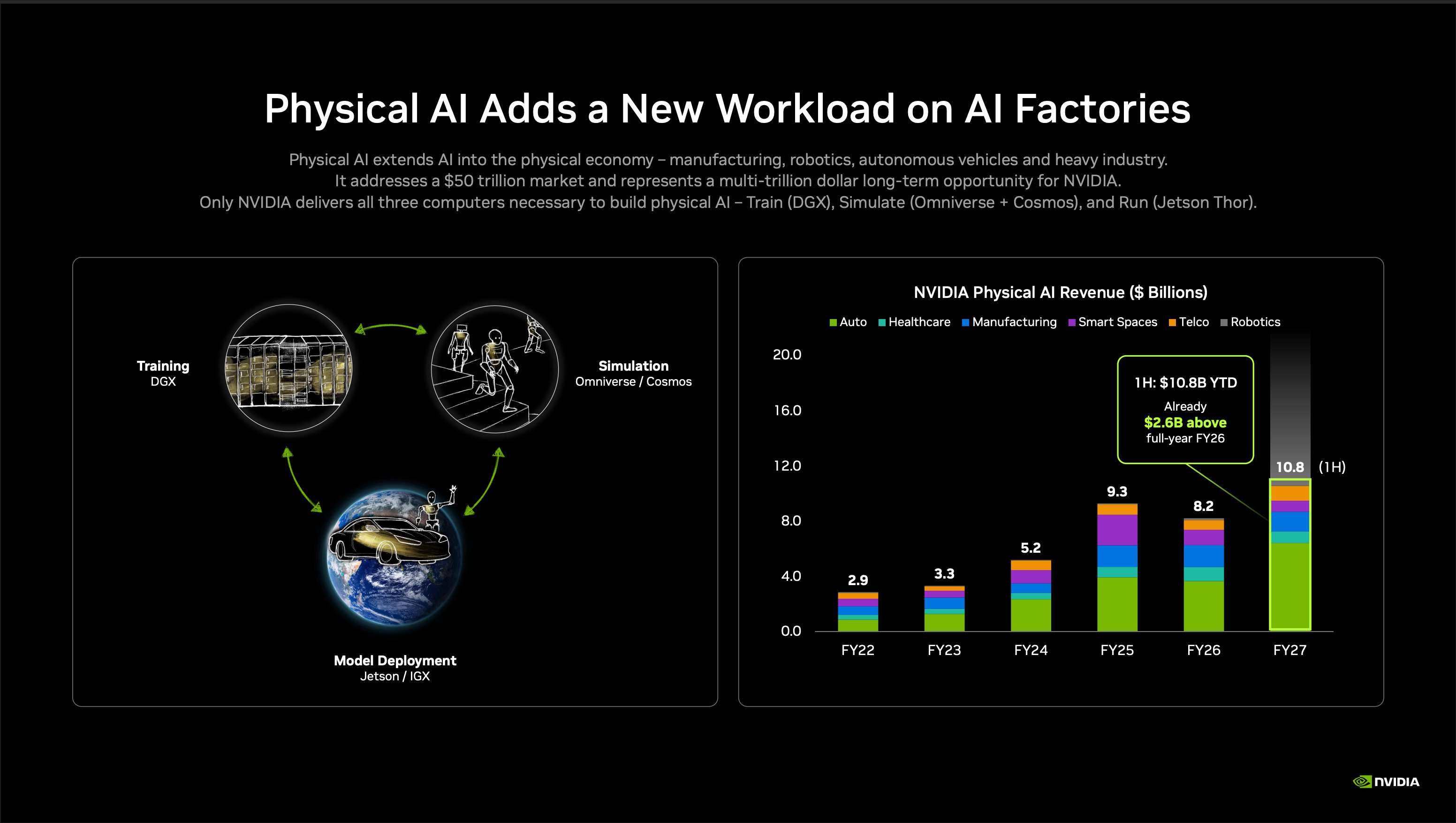
Physical AI Adds a New Workload on AI Factories
Physical AI extends AI into the physical economy – manufacturing, robotics, autonomous vehicles and heavy industry.
It addresses a $50 trillion market and represents a multi-trillion dollar long-term opportunity for NVIDIA.
Only NVIDIA delivers all three computers necessary to build physical AI – Train (DGX), Simulate (Omniverse + Cosmos), and Run (Jetson Thor).
NVIDIA Physical AI Revenue ($ Billions): FY22 2.9, FY23 3.3, FY24 5.2, FY25 9.3, FY26 8.2, FY27 10.8 (1H).
1H: $10.8B YTD. Already $2.6B above full-year FY26.
For my first post, I’m sharing a letter @NVIDIA signed on why open models matter.
AI will transform every industry, power every company, and be built by every country.
Open models strengthen safety and cybersecurity, accelerate innovation and diffusion, and enable sovereignty.
The world needs both frontier closed models and frontier open models.
https://images.nvidia.com/pdf/Open-Weights-and-American-AI-Leadership.pdf
Nvidia's computing stack is the best performance per TCO in the world, bar none. Nobody can demonstrate to me that any single platform in the world today has better performance TCO ratio. Not one company.
Dwarkesh Podcast, Jensen Huang interview, 15 April 2026.
You're going to have to go find another ASIC team in the world. Pick your ASIC team where you can say, 'I can bet the farm, I can bet my entire business that you will be here for me every single year. Your token cost will decrease by an order of magnitude every single year. I can count on it like I can count on the clock.'
Dwarkesh Podcast, Jensen Huang interview, 15 April 2026.
My point is that none of the bottlenecks last longer than a couple two three years. None of them. And meanwhile, meanwhile we're improving computing efficiency by 10x, 20x in the case of Hopper to Blackwell, some 30, 50x.
Dwarkesh Podcast, Jensen Huang interview, 15 April 2026.
The reason for that is fairly fundamental, which is the ability for general purpose computing to continue to scale has largely run its course. And the way to do that is through domain-specific acceleration.
Dwarkesh Podcast, Jensen Huang interview, 15 April 2026.
For example, notice people aren't talking very much about CoWoS anymore. And the reason for that is because for two years we swarmed the living daylights out of it. And we double double on several doubles and now, I think we're in a fairly good shape.
Dwarkesh Podcast, Jensen Huang interview, 15 April 2026.
The install base is, in fact, the single most important part of an architecture. The architecture could attract enormous amounts of criticism. For example, no architecture has ever attracted more criticism than the x86, as a less than elegant architecture, but yet it is the defining architecture of today.
Lex Fridman Podcast, Jensen Huang interview, 23 March 2026.
And that was always illogical to me because inference is thinking, and I think thinking is hard. Thinking is way harder than reading. Pre-training is just memorization and generalization, and looking for patterns in relationships.
Lex Fridman Podcast, Jensen Huang interview, 23 March 2026.
Power is a concern, but it's not the only concern. But that's the reason why we're pushing so hard on extreme co-design, so that we can improve the tokens per second per watt orders of magnitude every single year.
Lex Fridman Podcast, Jensen Huang interview, 23 March 2026.
We're now building factories. Warehouses don't make much money. Factories directly correlates with a company's revenues. And so the computer did two things. Not only did it change the way it did it, its purpose in the world changed. It's no longer a computer, it's a factory. It's a factory is used for generation of revenues.
Lex Fridman Podcast, Jensen Huang interview, 23 March 2026.
Physical AI is the technology industry's first opportunity to address a $50 trillion industry that has largely been void of technology until now. We started 10 years ago. We're seeing it inflecting now. It's close to 10 billion a year now, and it's growing exponentially.
You should not equate the price of the factory and the cost of the tokens. It is very likely that the $50 billion factory will generate for you the lowest cost tokens.
I believe we fundamentally need models as a proprietary product as well as models as open source. These two things are not A or B. It's A and B. A model is a technology, not a product.
Two and a half years ago I introduced the operating system of the AI factory. It's called Dynamo. Inside Dynamo, the fundamental technology is disaggregated inference. Some of the pipeline runs on some GPUs, and the rest runs on different GPUs. We went from a one-rack company and added four more racks. NVIDIA's TAM increased, call it 33 to 50% higher. BlueField, Groq processors, CPUs, and networking. All of it running the computer of the AI revolution, called agents.
Twenty billion of that factory is just land, power and shell. Storage, networking, CPUs, servers and cooling are there anyway. Full price or half price on the GPU is not $50 billion versus $30 billion. Say $50 billion versus $40 billion. That is not a large percentage when the $50 billion data center has 10 times the throughput. Even when the chips are free, it's not cheap enough.
OpenClaw is open, and it structures a computing model that is reinventing computing. It has a memory system. It manages resources and does scheduling. It can spawn agents. It has input and output, and an API that runs skills. These elements define a computer. We have a personal artificial intelligence computer for the very first time. It's open source. It runs literally everywhere.
Agentic software has access to sensitive information. It executes code. It can communicate externally. All of it has to be governed. All of it has to be secure. We have policies that give these agents two of the three things, but not all three things at the same time.
Say you have a software engineer or an AI researcher and you pay them $500,000 a year. At the end of the year I'm going to ask how much they spent in tokens. If that $500,000 engineer did not consume at least $250,000 worth of tokens, I am going to be deeply alarmed. This is no different than a chip designer who says they're going to use paper and pencil and they don't need CAD tools.
Everybody's job has a purpose and its task. The task is studying the scans. The purpose is helping the doctors, helping the patient diagnose disease. Computer vision has been integrated into radiology, and the surprising outcome is the number of radiologists went up. Because the scans get done so quickly, they can do more scans, patients get treated faster, and the revenues go up.
Now, remember everything you were just seeing, that is not animation. It's not a movie. It's a simulation. That simulation is an Omniverse. Omniverse, the digital twin. So these digital twins of factories, digital twins of warehouses, digital twins of surgical rooms, digital twins where Blue could learn how to manipulate and navigate and interact with the world. All completely done in real time.
GTC Washington, D.C., Jensen Huang keynote, 28 October 2025.
So this is what we talked about today. We talked about a large number of things. We spoke about, remember at the core of this are two platform transitions from general purpose computing to accelerated computing. Nvidia CUDA and those suite of libraries called CUDA-X has enabled us to address practically every industry, and we're at the inflection point. It is now growing as a virtual cycle would suggest. The second inflection point is now upon us. The second platform transition, AI from classical handwritten software to artificial intelligence. Two platform transitioning happening at the same time, which is the reason why we're feeling such incredible growth.
GTC Washington, D.C., Jensen Huang keynote, 28 October 2025.
We now have two exponentials. These two exponentials, one is the exponential compute requirement of the three scaling law. And the second exponential, the more people, the smarter it is, the more people use it, the more people use it, the more computing it needs. Two exponentials now putting pressure on the world's computational resource at exactly the time when I told you earlier that Moore's law has largely ended.
GTC Washington, D.C., Jensen Huang keynote, 28 October 2025.
A robotaxi is essentially an AI chauffeur. Now, one of the things that we're doing today, we're announcing the NVIDIA DRIVE Hyperion. This is a big deal. We created this architecture so that every car company in the world could create cars, vehicles could be commercial, could be passenger, could be dedicated to robotaxi.
GTC Washington, D.C., Jensen Huang keynote, 28 October 2025.
We also observed that someday transistors will continue the number of transistors will grow, but the performance and the power of transistors will slow down. That Moore's Law will not continue, beyond limited by the laws of physics. And that moment has now arrived. Dennard scaling has stopped. It's called Dennard scaling. Dennard scaling has stopped nearly a decade ago, and in fact, the transistor performance and its power associated has slowed.
GTC Washington, D.C., Jensen Huang keynote, 28 October 2025.
This says that the lowest cost tokens in the world are generated by Grace Blackwell NVLink 72, the most expensive computer. On the one hand, GB200 is the most expensive computer. On the other hand, its token generation capability is so great that it produces it at the lowest cost, because the tokens per second divided by the total cost of ownership of Grace Blackwell is so good. It is the lowest cost way to generate tokens.
GTC Washington, D.C., Jensen Huang keynote, 28 October 2025.