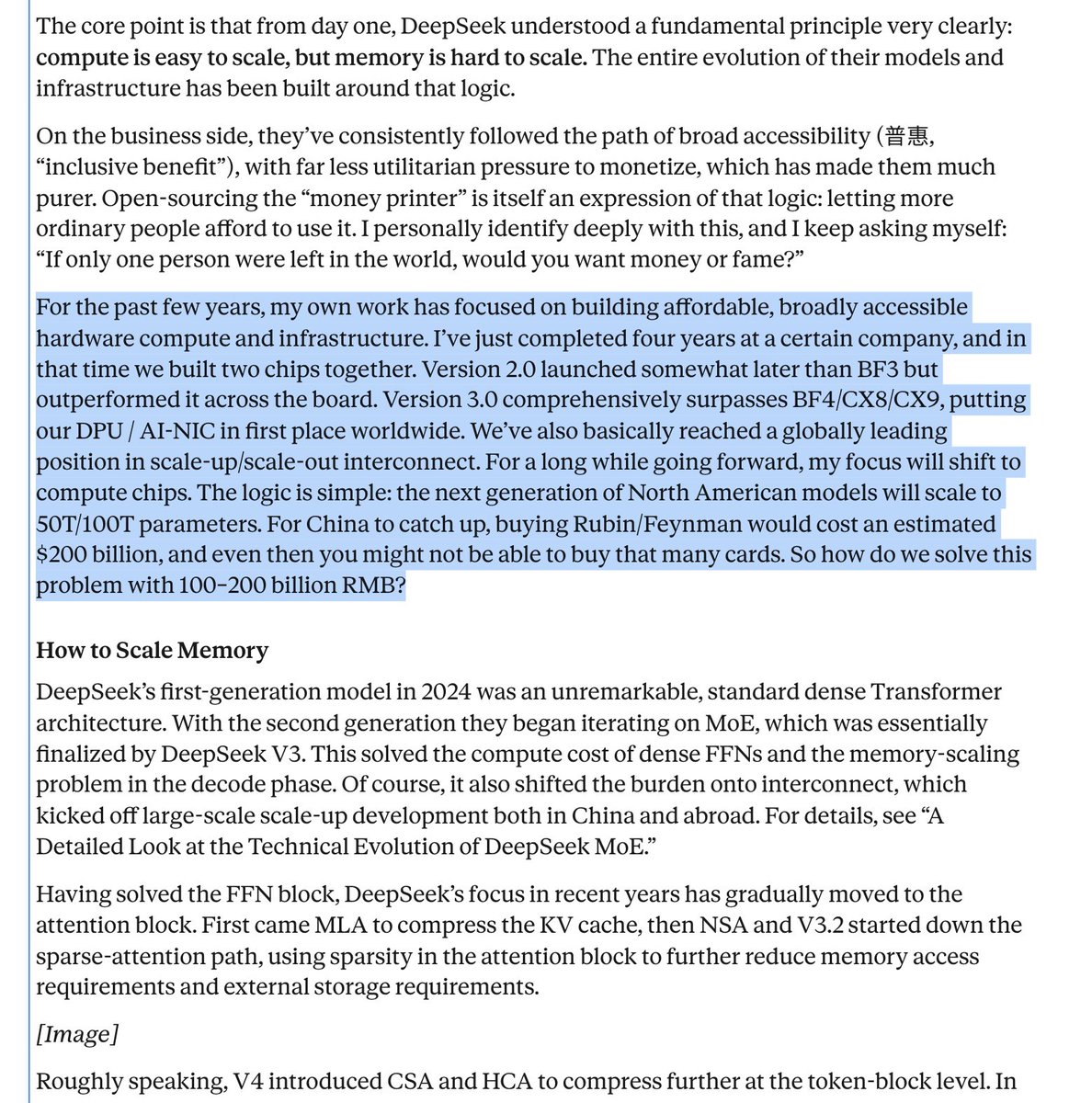
Zartbot is in awe of DeepSeek but that's natural.
The best part for me here was a peek into Zartbot's own work.
«the next [… ]US models will scale to 50T/100T parameters. For China to catch up, buying Rubin/Feynman would cost ≈$200B. How do we solve this with 100–200 B RMB?»
Quoted post · @jukan05
A new post from @zartbotF.
It’s an essay on DeepSeek open-sourcing its much-discussed “money-printing machine.” Zartbot argues that DeepSeek’s unique organizational setup is what enabled it to achieve an 80% gross margin.
At other labs, for example, each team has its own KPIs, leaving little room for compromise.
Even if an infrastructure engineer proposes compressing the KV cache further, they’ll inevitably face pushback from the algorithm team if it hurts model performance.
But the most interesting point in the piece goes a step further: even if the algorithm team agrees to experiment with a new architecture that enables greater KV cache compression, the experiment may fail to produce a leading model.
We saw this with V4. When DeepSeek V4 Pro came out and lagged behind GLM 5.3 and Kimi K3, everyone started saying DeepSeek was past its prime.
But Zartbot argues that this was one step back to take two steps forward, and that the work played a major role in the subsequent evolution of 4.1 Flash with CSA2.
A short but fascinating read. I’d encourage everyone to check it out.
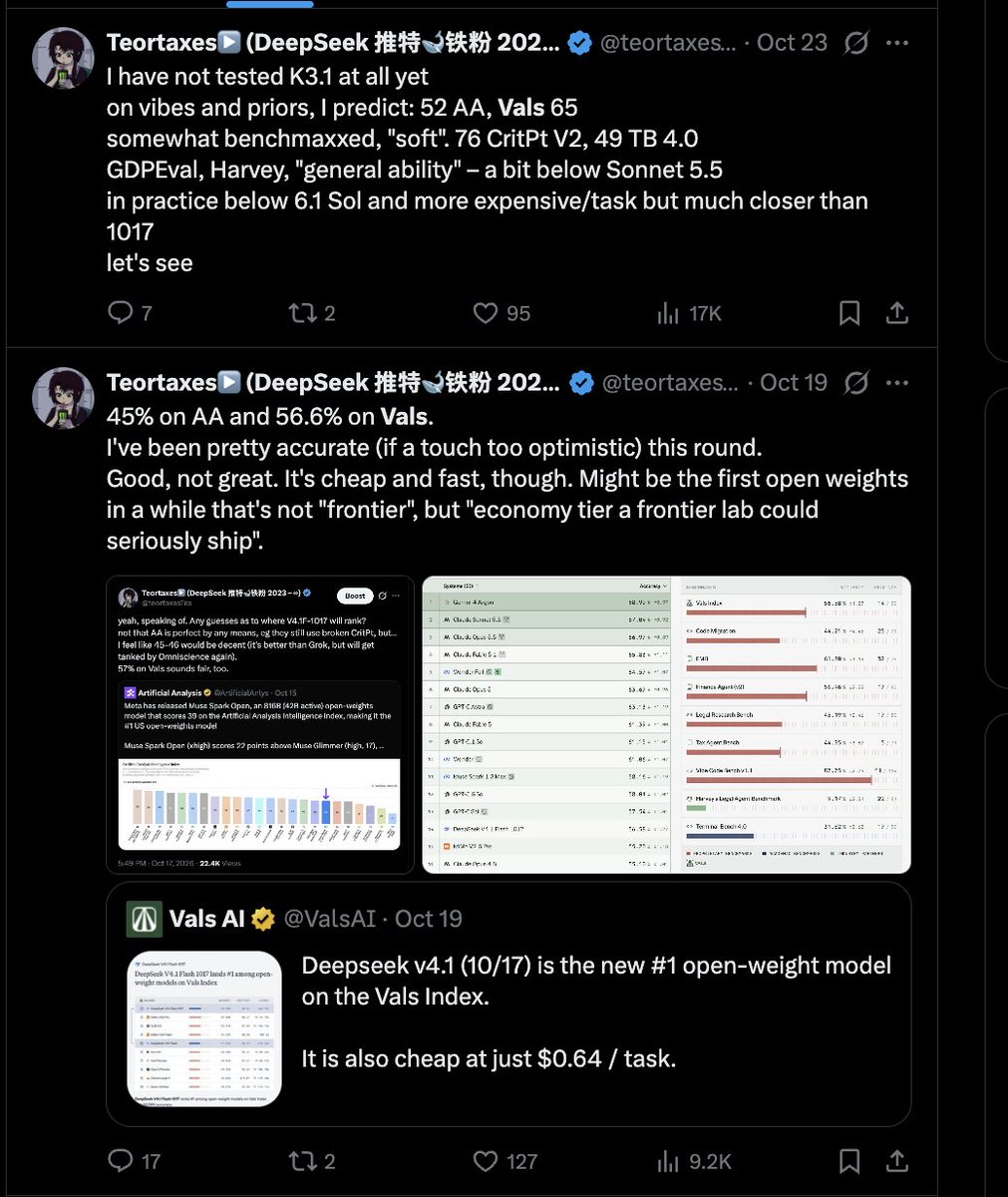
Interesting. I underestimated K3.1 Pro on AA and overestimated it on Vals by roughly the same value, even though I've been near perfectly calibrated wrt 1017. This makes me feel that Vals is the more trustworthy index right now.
Quoted post · @ValsAI
The long-awaited Kimi K3.1 is here, and it is #1 on our Vals Index amongst open-weight models (#8 overall)
Sebastian Raschka (@rasbt) has put together another hardcore tutorial — this time teaching you directly at the code level how a reasoning model is trained.
He paired his new book, "Build a Reasoning Model (From Scratch)", with an 8-part free video course totalling more than 11 hours.
Starting from a pretrained Qwen3 0.6B model, it walks step by step in PyTorch through implementing an answer verifier, inference-time compute scaling, GRPO reinforcement learning, and knowledge distillation, finishing with evaluating the model yourself.
The course design is very clever — especially writing the Verifier first to evaluate the model, and then turning it into the reward signal for reinforcement learning, which ties the entire training logic together immediately.
The author also specifically explains the relationship between reasoning models and Agents. If you mainly build Agents and Harnesses and want to understand where the underlying model's reasoning capability comes from, this book + video + code package is well worth bookmarking and coding along with.
Returning to China after 7 years away, Ruby on Rails creator DHH (@dhh) remarked that the changes in China "feel like 40 years have passed."
He recently visited Shenzhen, Hangzhou, and Beijing, and came back to write a long essay titled "Seven Years from China." Several details in it are quite interesting.
1. Riding in a Mercedes-Benz in China feels like going backward in time
Calling rides in China, he frequently rode in domestic luxury electric SUVs with leather seats and quiet cabins, sometimes for as little as $5 a trip.
When a hotel arranged a petrol Mercedes-Benz MPV for him once, he actually felt it was a bit outdated.
2. Xiaomi's car factory opened his eyes
He toured Xiaomi's car factory in Beijing, where almost no workers were visible on the production line — only a handful of employees with laptops supervising robots.
He has visited quite a few European car factories, yet had never seen this level of automation. Even more surprising to him: Xiaomi only launched its first car in 2024, and monthly deliveries now exceed 40,000 vehicles.
3. Execution speed at Chinese tech companies
Speaking with companies such as Alibaba, Tencent, Huawei, and Xiaomi, he clearly felt the pace of work here.
Emails and messages are often answered late at night and early in the morning. He also noticed that the large companies he visited are largely engineer-led, and almost all of them have their own AI models.
Of course, he also noted the human cost behind 996, as well as the inevitable filter of a one-week trip.
The piece is well worth reading, especially watching a founder who has lived in Western tech circles for a long time have many of his past assumptions shaken after observing China's tech industry firsthand.
That outside first-person perspective is sometimes more interesting than our own internal discussions.
> It still trails DeepSeek V4.1 Flash 1017, which found 54 vulnerabilities for only $7.53. That is seven more findings at roughly 16.6× lower cost.
at least we're going to be safe…
Quoted post · @Zaddyzaddy
We gave Moonshot’s new Kimi K3.1 Pro 100 pull requests with known vulnerabilities and one hour per PR to find them in the @BugBunny_ai VulnPR-100 benchmark.
It found 47/100 for $124.69.
That is 10 more vulnerabilities than Kimi K3 while costing $20.54 less. Cost per finding dropped from $3.93 to $2.65, a 33% improvement.
K3.1 Pro beat GPT-6 Astra and Muse Wonder 1.0, both at 46, and landed just one finding behind Claude Opus 5 while costing 3.6× less.
It still trails DeepSeek V4.1 Flash 1017, which found 54 vulnerabilities for only $7.53. That is seven more findings at roughly 16.6× lower cost.
A strong generational improvement from @Kimi_Moonshot, but DeepSeek remains the model to beat on cost-adjusted security performance.
Domestic models have been lively this week: on Monday MiniMax M3.1 Flash revealed its identity, and on Friday Kimi K3.1 Pro launched.
Going forward, my model evaluations will focus on two areas: video generation and 3D.
Plenty of people are already testing text and coding models; video and 3D are changing the fastest and are the hardest to evaluate clearly, so I want to test them thoroughly.
Quoted post · @Xudong07452910
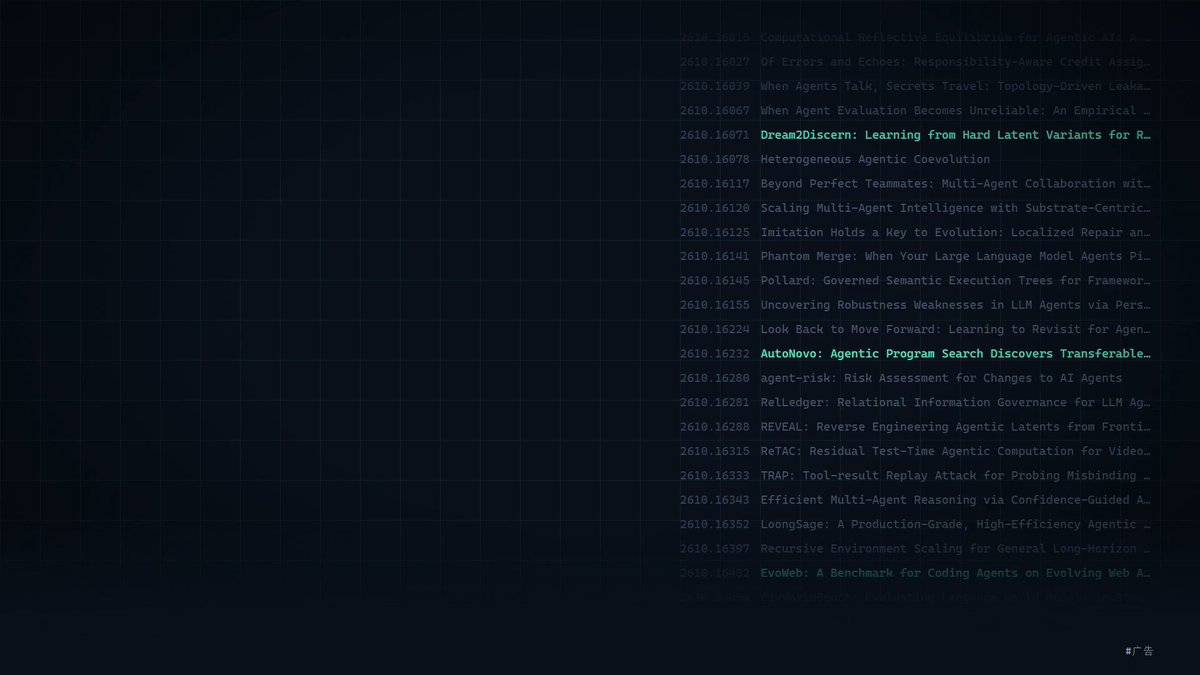
Last week on arXiv, there were 503 new papers with "Agent" in the title. Anyone working in this area knows it is impossible to read them all.
This time I handed the entire job to MiniMax M3.1 Flash — the model that previously topped the OpenRouter leaderboard anonymously as "Space Bunny."
I gave a single prompt in MiniMax Code and provided zero feedback afterward:
1. Called the arXiv API itself to fetch the data, backing off and retrying whenever rate-limited
2. Read all 503 abstracts in batches, tagging each paper with its topic, category, and Chinese summary
3. Wrote more than 4,000 lines of code to build a weekly digest website with radar charts, keyword constellations, linked filters, and BibTeX export
4. Wrote its own tests, inspected screenshots, fixed bugs, and passed all 96 checks at the end
86 minutes unattended, costing $0.88 at public API prices. For comparison, the same token usage on Claude Sonnet 5.5 at public pricing would be $8.46, roughly 9.6x the cost of M3.1 Flash (standard pricing on both official pricing pages, checked 22 October).
I verified all 503 arXiv IDs — every one is a real paper — and spot-checked 30 papers, finding 29 summaries consistent with their abstracts. For a long-horizon, multi-tool agent task, I am quite satisfied with this performance.
Anthropic has recently started advising enterprises to "use fewer Subagents," and even to merge some specialist Agents back into the main Agent Loop.
Across multiple enterprise projects, they found that a single Agent + Skills often performs better than a complex multi-agent architecture. One customer saw runtime speed improve by roughly 2x after switching to a single loop.
The reason is easy to understand.
When multiple Agents repeatedly hand off tasks to one another, they have to pass and summarise Context each time — information is easily lost, and latency and cost rise alongside it.
Anthropic now recommends having one main Agent handle planning and execution, dynamically loading Skills and Tools when needed, and keeping business workflows and domain knowledge inside reusable components.
However, one detail in the article deserves attention.
They once merged Subagents in a customer-support system; latency did drop, but a task that previously succeeded started failing because the main Agent skipped the step of confirming delivery times with the logistics specialist.
So the authors emphasise that every time you merge a Subagent, you must validate with end-to-end Evals — specifically checking which previously passing tasks suddenly fail.
Of course, for parallel research, independent verification, and Context isolation, Subagents remain valuable.
Viewed this way, when designing a Multi-Agent system in the future, you should probably ask yourself first: does each Subagent truly need its own isolated Context and execution loop?
Anthropic also open-sourced a migration toolkit that analyses your existing architecture, merges Subagents step by step, and compares quality, cost, and latency before and after. Highly recommended for anyone working on Agent engineering.
Last week on arXiv, there were 503 new papers with "Agent" in the title. Anyone working in this area knows it is impossible to read them all.
This time I handed the entire job to MiniMax M3.1 Flash — the model that previously topped the OpenRouter leaderboard anonymously as "Space Bunny."
I gave a single prompt in MiniMax Code and provided zero feedback afterward:
1. Called the arXiv API itself to fetch the data, backing off and retrying whenever rate-limited
2. Read all 503 abstracts in batches, tagging each paper with its topic, category, and Chinese summary
3. Wrote more than 4,000 lines of code to build a weekly digest website with radar charts, keyword constellations, linked filters, and BibTeX export
4. Wrote its own tests, inspected screenshots, fixed bugs, and passed all 96 checks at the end
86 minutes unattended, costing $0.88 at public API prices. For comparison, the same token usage on Claude Sonnet 5.5 at public pricing would be $8.46, roughly 9.6x the cost of M3.1 Flash (standard pricing on both official pricing pages, checked 22 October).
I verified all 503 arXiv IDs — every one is a real paper — and spot-checked 30 papers, finding 29 summaries consistent with their abstracts. For a long-horizon, multi-tool agent task, I am quite satisfied with this performance.
Moonshot AI released Kimi K3.1 Pro on 23 October, available the same day across the Kimi web app and mobile app, the office assistant Kimi Work, the coding tool Kimi Code, and the API.
Moonshot calls it its strongest open-weight model to date, with full weights scheduled for release before 4 November.
K3.1 Pro was trained by continuing from the previous generation Kimi K3 without changing the model architecture, spending substantial compute on reinforcement learning — having the model repeatedly perform tasks across hundreds of domains and improve based on scored outcomes.
The model has 2.8 trillion total parameters and activates roughly 104 billion per token (a token is the unit AI uses to process text, roughly a word fragment). This architecture is a Mixture of Experts (MoE): the model contains many specialised "expert" sub-networks and calls only a small fraction of them each time, making computation faster than a dense model of the same size, though the entire model still has to fit in memory. It can read 1 million tokens at once — equivalent to a medium-sized codebase or several hundred pages of financial filings — and also processes images and video.
[How it compares with Claude and GPT]
The scores below come from Moonshot's own comparison table against Anthropic's Claude Opus 5.5, Claude Fable 5.1, and OpenAI's GPT-6 Astra, with all models set to maximum reasoning effort. Several competitor figures were measured internally by Kimi and cannot be independently reproduced.
Coding is roughly at parity.
On Terminal-Bench 4.0, which completes real development tasks in the command line, K3.1 Pro scored 65.7%, Opus 5.5 scored 66.4%, and GPT-6 Astra scored 58.2%. On SWE-Marathon for large software projects, K3.1 Pro ranked first at 51.7 versus 46.3 for Opus 5.5. On scientific computing (Terminal-Bench Science), the gap remains wide: K3.1 Pro scored 38.1 versus 68.1 for GPT-6 Astra.
3D modelling is slightly behind.
K3.1 Pro can write scripts directly to operate Blender, CAD software, and the Unity, Unreal, and Godot game engines; official demos produced a complete 3D game and a 3D-printable desk lamp. On BenchCAD — reconstructing parts in CAD code from rendered images — K3.1 Pro scored 92.7%, compared with 96.2% for Opus 5.5 and 95.9% for GPT-6 Astra.
Finance is the headline strength of this release.
On OfficeQA Pro v2, which reads real financial documents and performs multi-step calculations, K3.1 Pro ranked first at 64.4 versus 62.2 for Opus 5.5. In Kimi's internal tests, financial modelling improved by 7.2 points over K3, and research-report writing improved by 11.6 points.
The announced "65% reduction in hallucination" comes from Kimi's internal adversarial fact-checking test: K3 got 23 out of every 100 facts wrong, whereas K3.1 Pro dropped to just over 8. On the same test, Opus 5.5 made 15 errors and GPT-6 Astra made 5.5. Moonshot notes that this is a stress test and does not represent everyday error rates.
[What it costs, and whether you can self-host it]
Regular users can access it on the Kimi web app and mobile app; Moonshot did not specify the free-tier quota. Enterprise workspaces have it disabled by default until an administrator turns it on.
API pricing is $2 per million input tokens and $10 per million output tokens — two-thirds the price of K3. Claude Opus 5.5 costs $4 input and $20 output, or twice as much. The Highspeed tier (2x to 3x faster) is priced at $4 input and $20 output, matching Opus 5.5. API accounts require at least a $1 top-up before use.
Open weights mean the model files are public so anyone can download, run, and fine-tune them on their own servers without routing data through Moonshot. However, a personal computer cannot run it: based on the 4-bit precision used by K3, simply holding 2.8 trillion parameters in memory requires roughly 1.4 TB of RAM. Licence terms have not yet been announced.
To release open weights, Moonshot says it removed cyber-offence and cyber-defence data during training. Using the same training pipeline without removing that data, the model solved 90.5% of problems on an internal exploit benchmark; after removal, the score dropped to 81.0%. Moonshot states that its offensive cyber capability still trails top closed-source models released more than three months ago.
Quoted post · @Kimi_Moonshot
Introducing Kimi K3.1 Pro: our most capable 3T-class open-weight model.
🔹 1M-token context, 2.8T total / 104B active params (MoE), Multimodal.
🔹 Full-project coding: games in Unreal, Unity & Godot.
🔹 Excels at parametric 3D modeling in Blender & CAD.
🔹 More reliable at finance work: Accurate modeling with hallucination down by 65%.
🔹 Matching the strongest proprietary models across coding, agentic and knowledge benchmarks.
Kimi K3.1 Pro and K3.1 Pro Highspeed (2–3× faster) are now live on https://t.co/85jA71X9gw, Kimi Work, Kimi Code, and the Kimi API.
Open weights by Nov 4, 2026.
🔗 API: https://t.co/XCrgjXAqMw
🔗 Tech blog:
AI talent is no longer as scarce as it used to be.
Quoted post · @latepostnews
As the AI talent bidding war ebbs, even "geniuses" are now being screened selectively
- Foundation-model companies once offered million-RMB annual packages to young researchers who had yet to produce industrial results. They built teams rapidly and tried every means to lock in smart, high-potential people. ByteDance at one point hired people first and figured out a role for them later. Now that is changing.
- In this autumn's recruiting season, a 2027 PhD candidate with six top-conference papers and foundation-model internships at two leading tech giants applied to more than twenty companies' elite talent programmes. He originally expected twelve or thirteen offers; by late October he had only five or six expressions of interest, and the outcomes at Tencent and Alibaba fell short of expectations. High-salary recruiting still happens, but there are far fewer openings.
- CVs look stronger, yet opportunities have shrunk. Some candidates completed three technical interview rounds only to be told by HR that technical priorities had shifted and the role was cancelled. Processes have also slowed: one candidate following up on interview progress reported "no reply once, twice, three times, and no reply to nudges after that." When companies were scrambling to hire, HR would check in every few days to "keep candidates warm" and even bring flowers to campus to celebrate signed students. As one head of recruiting at a leading foundation-model lab put it: "Foundation-model teams across the industry are cutting both campus and lateral hiring quotas — that is basically the consensus this year."
- Sam, who tracks AI talent flows closely, calls the current market a "K-shaped divergence": researchers with hands-on experience in large-scale pretraining, reinforcement learning, or 10,000-GPU cluster infrastructure still command premium packages, while junior candidates relying mainly on academic papers without training experience see fewer opportunities. A headhunter who recruits for model labs said teams used to be happy to meet any promising profile; now they compare candidates directly against existing team members to ask what specific gap they fill or what new capability they bring.
- Behind this shift is a finer division of labour inside foundation-model R&D. Early on, nobody knew the exact recipe, so individuals holding key know-how were critical; once training pipelines became standardised, "people are no longer the core factor of production." One insider compared foundation-model R&D to "manufacturing": data cleaning, small-model experiments, reinforcement learning, and model merging. Once each stage is standardised, companies know much more precisely where they actually need headcount.
- Candidate CVs also look increasingly polished — internships at Kimi or DeepSeek, technical blogs, open-source projects with thousands of GitHub stars, and Olympiad gold medals all show up — but interviewers hold stacks of equally impressive profiles. A beautiful CV does not guarantee independent research judgement: one recruiting lead noted that some candidates can explain what experiments they ran and what results they got, yet cannot articulate the reasoning behind their choices. As teams mature, companies need people who can frame problems, make judgements, and solve issues independently rather than merely execute assigned tasks.
- In this environment, referrals from trusted collaborators carry much more weight. People who have worked on a project together know who actually proposed the idea and solved the problem, whereas paper authorship and CVs rarely reveal individual contribution. Alumni, labmates, and former colleagues across foundation-model circles stay closely connected, and hiring is increasingly concentrated among a handful of university labs and teams where capability comes bundled with "a transfer of trust."
- That also makes it harder for outsiders without those networks to break in. One researcher who hit walls with several model teams last year decided to stop mass-applying and spend time building a stronger piece of work first: "Build a signature piece, publish it... and let them come find me." New teams did eventually reach out, though the path was far more circuitous than an internal referral.
- Harder recruiting affects not only compensation and titles, but whether young researchers can get real training experience at all. Labmates from adjacent cohorts with similar backgrounds may see one land a talent-programme offer while the next year's graduate does not. Those who entered core teams earlier have already participated in frontier runs, whereas newcomers now need prior training experience just to get onto a project. Many interns are confined to data-mixture tuning and small-scale ablations, with fewer chances to touch core architecture work. As one investor remarked: "Talent is shaped by the environment — and right now, that environment for shaping new talent barely exists."
- A student in a top talent programme noted that while his team permits exploration, compute allocation follows strict priorities: the company directs most GPUs toward Coding, pushing other directions to the back of the queue — "you need GPUs before you can talk about anything else." That stratification starts even earlier on campus, where students must first secure advisor funding, compute, or industry partnerships to publish papers, use those papers to land a first internship, and then parlay internship results into the next opportunity.
Sharp China: New Export Controls in Multiple Sectors; Q3 GDP and the Fifth Plenum; Europe Presses Forward; OpenAI and Nvidia Chips
On today’s show Andrew and Bill begin with a raft of proposed export controls from Beijing on AI-related technologies, solar-related technologies, and machinery, as well as continued angst surrounding Japan’s rare earth access. Then: Reactions to strong Q3 GDP numbers in the PRC, continued stock market struggles, questions about GDP targets, and speculation about the agenda for next week’s Fifth Plenum. At the end: The EU signals a willingness to continue protectionist measures in new sectors, a report on new investment deals between the US and China, a potential Putin-Xi-Trump summit, sanctions on China’s version of Y Combinator, and a Politico report on OpenAI’s suddenly restrained export control lobbying, which spawns a variety of thoughts on the state of US chip policy.
Personal Agent trend thesis:
Whether it is Muse, Dot, or Grok Bot...
Right now, the pattern is still that you talk to it, and it completes a few tasks.
Yet in our daily life and work, executing isolated tasks is only one part — a huge share of our time is spent on communication.
Whether in-person conversations, messaging, phone calls, video meetings, and so on.
An Agent system that cannot communicate with other people on your behalf is incomplete.
For an Agent to communicate on your behalf, it needs three prerequisites:
1. Understand you: The Agent knows who you are and your communication habits — Memory & Soul.
2. Understand the counterpart: The Agent knows who it is speaking with, the communication Context, and the next communication Target.
3. Understand how to communicate and be able to execute: The Agent knows communication Skills, knows how to prepare the right materials (documents, images, slide decks, animated videos...), knows how to operate communication tools (Zoom, Slack...), and can listen, see, and speak through multimodal capabilities (TTS, ASR...).
Almost every underlying technology for this is already ready; all that is missing is the right mechanism to combine them.
In 2027, Agents that communicate on your behalf will become mainstream, and Agents that cannot will be pushed to the margins.
🚀 Introducing DeepInfer, our in-house inference framework, now fully open source!
Powering DeepSeek-V4.1-Flash at scale with high throughput and low latency. We’re sharing our production stack to help the community lower compute costs, reduce energy use, and make AI more affordable.
🔗 https://t.co/JGAik1kgk0
1/4
Q3 GDP growth on target; Xi on compute; Export controls; Fifth Plenum watch
In just a few days, the Fifth Plenary Session of the 20th Central Committee of the Party will convene in Beijing, making strategic deployments for the sustained promotion of full and strict Party self-governance. This is of great practical significance and long-term guiding importance for our Party to adhere to Xi Jinping Thought on Party Building and deepen the new great project of Party building in the new era. - Qiushi editorial
1. Export controls around AI, biomedicine, photovoltaic tech, drones and dredgers
3. Xi Jinping inspects Ulanqab, Inner Mongolia
Vision-related capabilities are rapidly advancing since we introduced vision to our flagship model. Now everyone can describe an idea and build their own games!
Quoted post · @deepseek_ai
🚀 DeepSeek-V4.1-Flash-1017 is here!
Stronger benchmark performance, faster task completion, and shorter outputs than the previous version—a Pareto improvement in performance and cost. Now live on our website, app, and API.
🛠️ Optimized for @DeepSeekHarness, Tencent CodeBuddy, WorkBuddy, and more. Upgrade to DeepSeek Harness v0.2.1-rc.1 or later for the best experience with the new model.
1/4
Silicon Valley, Seen from Beijing
Crossing the River bridges the information gap between China’s entrepreneurial ecosystem and the West — translating, summarizing, and contextualizing the Chinese-language content that rarely crosses the Pacific.
This post is a translated summary of “’’” , originally published on LatePost by Meng Xing. The author is a partner at 5Y Capital — #9 on our Crossing the River Top 25 China Investors list — and this piece inverts our usual direction of travel: a Chinese VC’s field notes from Silicon Valley, reporting what frontier-lab researchers there now say about China.
In August, Meng Xing drove south from SFO down the 101 and read the billboards — Silicon Valley’s most honest weathervane. Two years ago they were all SaaS; this year they are wall-to-wall AI, with Kimi now buying San Francisco billboards and Codex spending heavily to battle Claude Code. Nothing suggests AI is slowing down. What startled him was something else: judgments he’d never heard before, coming from the most central people.
Lei Jun’s Third Card: Xiaomi Bets Its SUV on China’s Families
Crossing the River bridges the information gap between China’s entrepreneurial ecosystem and the West — translating, summarizing, and contextualizing the Chinese-language content that rarely crosses the Pacific.
This post is a translated summary of “:?” , originally published on Tech (via Jiemian News) by Wang Lin and Ren Xueyun. Lei Jun is #7 on our Crossing the River 25 Founders list .
How many tricks can you still pull with a big family SUV? NIO founder Li Bin () — #18 on the Crossing the River 25 — climbed into the trunk of an Onvo L60 with his co-president; IM Motors hid a shower in theirs. Xiaomi’s new Pengcheng N90 Max goes further: a 2.9-meter flat floor you can play billiards on, a trunk that converts into a café, and a rooftop tent that turns the car into a “two-room apartment.”
In 3 days I replaced Granola, Typeless, Things, CleanShot X, Notion Calendar, Craft ...
Granola — $168/year
Things — $49.99
CleanShot X — $35
Typeless — $144/year
Craft — $76/year
......
Saving roughly $500 in total.
1. Replacing Things
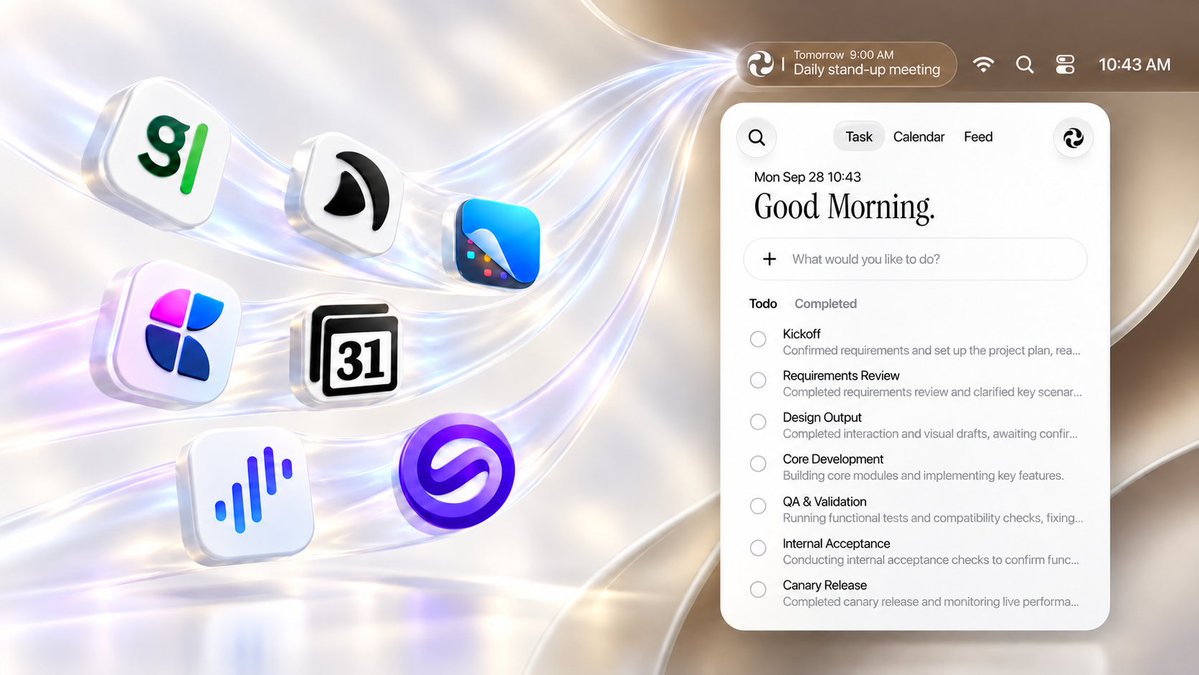
When you send a message in a chat UI with AI, that product form always makes you wait for an immediate reply, which creates waiting anxiety. So I wanted an interaction model where I issue a task instruction, the AI goes off to do it, and I don't have to babysit or wait for it. A todo list is one such form, and since I was already a Things user, I built a macOS menu-bar todo list tool. Under the hood it uses DeepSeek Flash, which responds very quickly; the Harness is Hermes, paired with a macos-harness so it can operate local software, and everyday tasks just work. I write my daily tasks in it: if it can do a task, it does it for me directly; if it cannot, the item sits quietly in the list for me to do and check off myself. Every task detail view is also an AI thread where I can ask it to do almost anything next.
2. Replacing Granola
I am a heavy meeting user, and having to click to start taking notes every time was annoying. So I built a feature into Telos that monitors when my Mac starts and ends a meeting. Once a meeting starts, it records the transcript, summarises it, and extracts the Todo items. Meeting detection and audio capture use ScreenCaptureKit + AVFoundation, local speech recognition runs on Qwen3-ASR, and the cloud model is still DeepSeek. Whenever I enter a video call, the Telos icon in the top-right menu bar starts spinning to show it is working, which gives me peace of mind.
3. Replacing CleanShot X
As more and more app icons crowded my menu bar, I wanted to see which ones I could eliminate. CleanShot X caught my eye first. It is just a screenshot utility — capture and annotation took minutes to build with AppKit + PaperKit. And I added a much more AI-native interaction: click and hold any spot on a screenshot, speak directly, and it generates an arrow and callout bubble right at that point. For filing product bugs with teammates, it is unreasonably convenient.
4. Replacing Typeless
I was actually an early evangelist for Typeless, and plenty of people around me started using it on my recommendation. But its free tier kept getting stingier, and paying for that narrow feature alone didn't feel worth it. So I used macOS Accessibility + AppKit to detect which text field the cursor is in and trigger push-to-talk from the trackpad; AVFoundation handles audio input, Qwen3-ASR 0.6B 4-bit transcribes mixed Chinese-English speech into text, and DeepSeek strips filler words, fixes punctuation, and cleans up phrasing... It feels even better than Typeless — point and speak anywhere.
.......
Next, I plan to replace Screen Studio for screen recording and Surge for proxy routing. All I need is a stable proxy tool. Surge ships a major version every so often that changes protocols and breaks older rule sets, effectively forcing you to pay to upgrade. CleanShot X is the same — every major version demands another payment or leaves an update badge sitting at the top of your screen forever.
So many of these apps wave the banner of one-time purchase while running a subscription model in disguise. As a builder I understand why they do it, but as a consumer it is annoying. In an economic downturn, the software ecosystem is entering a new kind of consumption downgrade: build it yourself, for yourself.
 InfrastructureX