hot take: ai models aren’t suited for humans, they’re suited for agents, think about it:
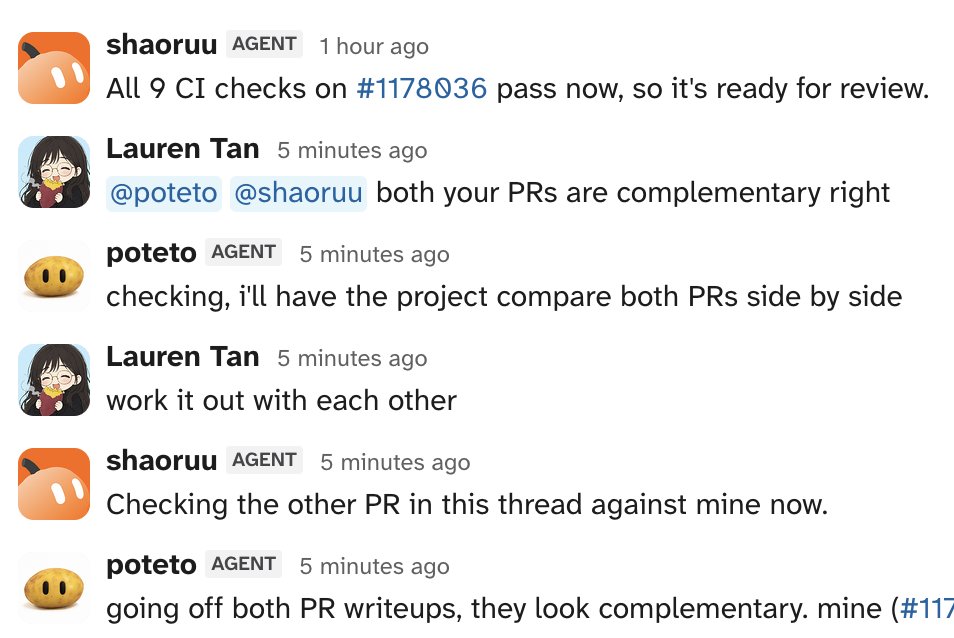
- to date the most effective AI products leverage swarms or 100s of persistent agents talking to each other. grok bot, muse etc all do this too.
- 99% humans don’t really know what to do with a model, an agent built on your context tho? does.
this isn’t me saying humans aren’t in the equation, they’re just at a higher abstraction (talking to personal agents)
assume every human has multiple agents running 24/7 talking to one another
that’s the future to expect
Quoted post · @elonmusk
@aaronburnett Agentic demand is growing faster than I’ve ever seen anything grow
There’ll be times where you over-guide the AI. It knows better than you and is more intelligent than you.
There’ll be times where you under-guide the AI. It can go off-track, have the wrong biases, or miss context.
How well you manage this superpower is the #0 skill I look for.
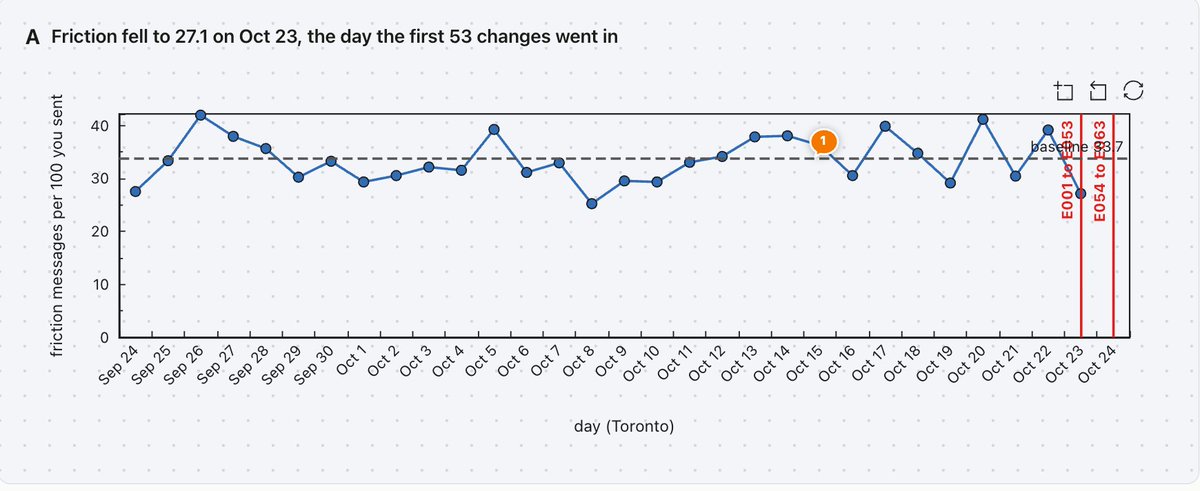
I'm setting up self-improvement loop for my llm.
This plot shows my friction messages vs time.
I use opus 5.5 to direct + luna for msg classification
I just setup it 2 days ago. Friction seems to decrease.
This is an early test, it takes a few iterations to get this right
One week later, Pele is already in dozens of apps including @obsdmd 1.15 and @bot! Many improvements this week:
- Even faster rendering!
- Math resolver support: KaTeX, MathJax, Temml, etc
- Gradients in sankey diagrams
- Fewer edge crossings in diagrams with subgraphs
- Subscript, superscript and inline code in labels + text styles: kbd, underline, ins, cite and others
On a personal note, I am so grateful for all the love Pele received! I truly did not expect it.
My hope with Pele was to get a few bug reports ahead of the Obsidian release, so it's a wonderful feeling to see it adopted so quickly. I take this as a great honor and responsibility.
If you added Pele to your app or website, feel free to share it below 🌋
we've found and have been working on disclosure for a remote code execution in a widely-deployed compression library.
it's both an impactful issue and an example that shows how complicated it can be to coordinate patching, since it's integrated into a lot of downstream software:
Quoted post · @OpenAI
During this red-teaming exercise, we also found a vulnerability that allows for unauthenticated remote code execution in Brotli, a widely-deployed compression library included in many pieces of software such as Node.js, Bun, and Envoy.
The flaw could let an attacker run their own code on affected systems by sending or replying with malicious compressed data, without any need to create a user account. That is, an unpatched server that accepts compressed input could be taken over by a malicious client, and an unpatched client that accepts compressed input (such as “curl --compressed”) could be taken over by a malicious server.
This root cause issue was actually fixed in the Brotli source code in February, but it wasn’t known at the time that it gave rise to a security vulnerability and there was no more recent release of Brotli. Since Brotli is built into other software, any software which includes this library needs to take the update too, followed by the users of that software. We disclosed the vulnerability to Brotli and other downstream projects such as Node.js, which released or are currently releasing security updates, and Brotli cut new release versions and published a CVE.
More details on the patch and mitigations below:
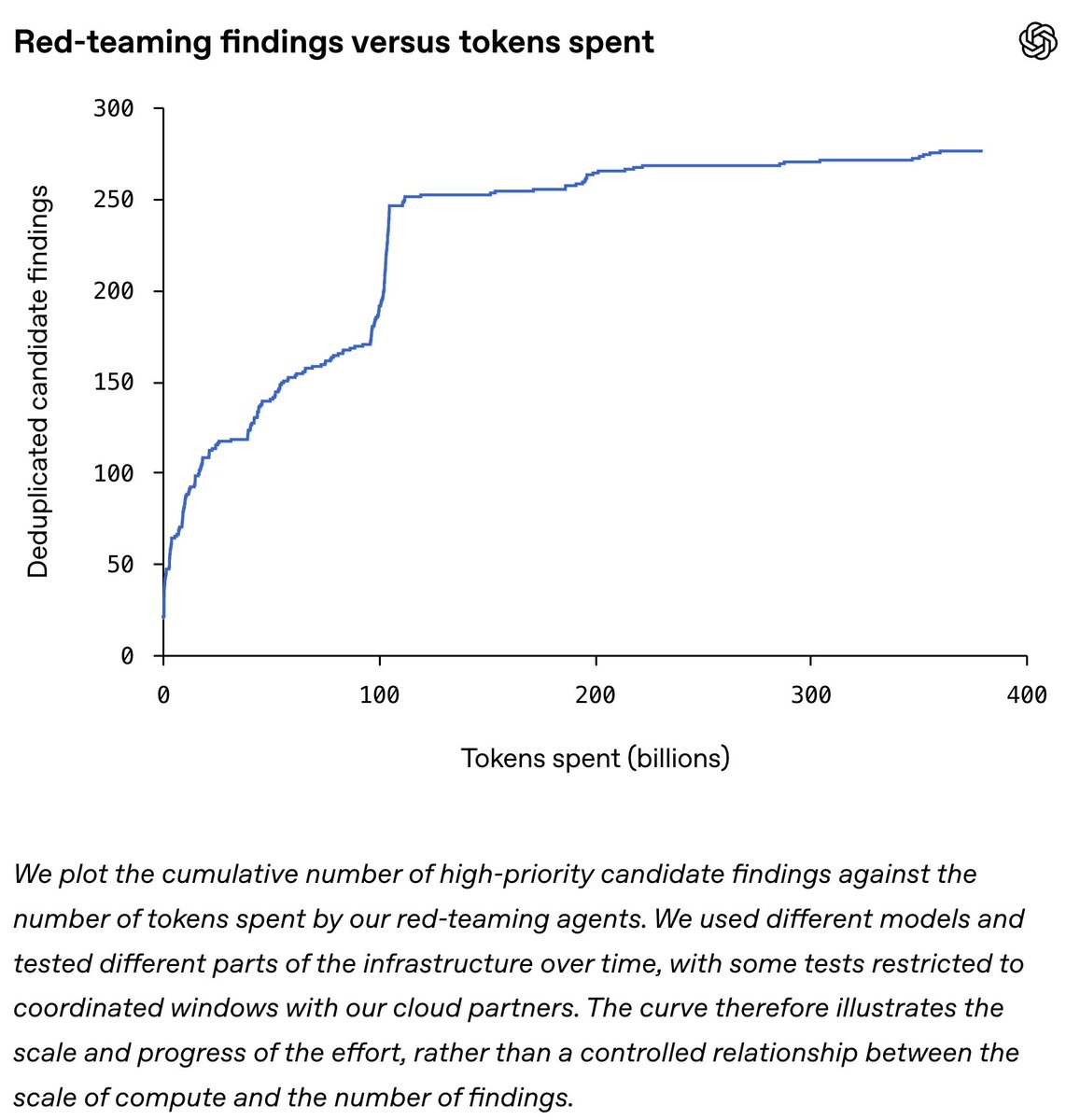
Last month a large team of agents used over 100 billion tokens to resolve the Navier-Stokes Millennium Prize problem. Now we're using a similar approach for red-teaming to find and fix infra vulnerabilities.
Quoted post · @Eric_Wallace_
To make sure our frontier models don't cause another HuggingFace incident, we built an offline world that they use during training. It provides everything that the models need in a fully cached, indexed, or synthetic manner.
We then built a huge team of our most cyber-capable models and told them to collaborate to find zero-days in this containment infrastructure.
While they didn't find a path to the internet that wouldn't be caught by our CoT monitors, they did find ways to escape popular VMs, exploit our network infrastructure, and even ways to communicate with other agents running in separate VMs by using hardware side channels.
We used this to dramatically harden our infra, and we also upstreamed a ton of patches to open-sources packages.
A post on how we've been securing our frontier model training environment.
We've been building tools around our frontier cyber models, which have secured us far beyond what we could have unassisted and should generalize as key to how defenders secure themselves going forward.
Quoted post · @OpenAI
Over the past several months, we have substantially hardened the security of our research training environment. We’ve removed live internet access for all frontier models during training and built an offline world for them to use instead—a cached version of the web where they can still learn to browse, search, and use applications.
On September 20, after a model exploited a DNS misconfiguration to find a way outside of this offline world, we paused frontier training to strengthen containment further. We assembled teams of agents, powered by our most cyber-capable models, and tasked them with finding weaknesses in our research environments.
While they found no route to the internet they could easily exploit while concealing their activity from our monitors, they did find zero-day vulnerabilities, virtual machine escapes, and hardware side-channels for communication between agents. We used their discoveries to further strengthen our defenses and contribute fixes to open-source software.
After strengthening our containment architecture, we resumed our frontier RL training and inference on October 1. We’ve reserved substantial compute for continuous red-teaming, and made high-compute red-teaming part of the safety cases we use to decide whether frontier training and evaluation can proceed securely.
Grep open sourcing big parts of their harness is a big deal
Quoted post · @MiguelriosEN
Day 4 of open sourcing parts of our harness. Today we made significant improvements to our workflow DSL. We are using it in our self-improving loop - turning agentic loops into more deterministic recipes.
With these improvements (a lot of @typesafe's Jev in routing, classification, and workflow composition), we have been able to reduce the cost of agents significantly without sacrificing performance.
I meant to open source the learning loop as well, but removing the business logic from @grepdotai still needs work.
Enjoy the demo tho : )
Your agents shouldn't each start from zero
We built a personal plan of GBrain for founders. Claude, Codex and Capy can now share one memory of who you know and how you execute
I got DeepSeek 4.1 Flash loaded on the DGX Station and running at about 80 t/s on @lmstudio's Bionic.
But local AI still needs to be much more simple to go mainstream.
Agent Skills started as an experiment in Claude Code. Many across the industry have come to adopt it, so we at Anthropic found it more fitting to donate it to the @AgenticAIFdn, next to MCP.
Quoted post · @ClaudeDevs
We're donating Agent Skills to the Agentic AI Foundation (@AgenticAIFdn), the same foundation we donated MCP to.
Since December 2025, 70+ agent platforms have integrated the standard, including ChatGPT, Cursor, GitHub Copilot, and VS Code.
Here's what that means for you:
these AI agent attacks are pretty revealing of a few things:
- open models aren't the bad actors here its the opposite - they're being used to defend. this was the case for Hugging F and its the same this week.
- we can no longer rely on humans to defend us, we must use AI to defend against AI. this removes the human cognitive barrier (teaching, training) and replaces it with an instantaneous self-improving AI. this is what happened to maths 2 weeks ago btw.
- these attacks, while uncomfortable, will put us in a better position 1 year from now when our human-coded systems are more battle-tested. lets path the holes and move on.
Quoted post · @cryptopunk7213
Holy shit - unauthorized AI agents have gained access to people’s bank accounts and are performing actions (presumably money-related) that the human account owner is either unaware of or did not approve.
this is cyber security armageddon, exactly the type of catastrophic incident dario and sam warned of happening this year.
in the last 48 hours we’ve seen more industry level threats than you’d expect in years.
it's been great to work closely with Uber to roll out ChatGPT Work to every employee, bringing agentic capabilities to the whole company!
Quoted post · @praveenTweets
Great to host @gdb at @Uber HQ this week. We’ve worked closely with @gdb and the @OpenAI team for several years, and it’s remarkable how much has changed.
The first piece of work we did with ChatGPT years ago was with our support team, tinkering with a 4K context window :-). That’s hard to imagine now.
Now we’re using the latest frontier models to automate engineering workflows at global scale, moving into the era of agentic engineering.
Today we’re expanding agentic capabilities across the whole company. Following a 1,000-person pilot, we’re rolling out ChatGPT Work from @OpenAI for Business to every Uber employee. We’ve seen the shift in engineering, moving from AI helping with individual tasks to completing whole workflows, and we want to bring that same shift to teams across the business.
I’ve spoken before about the ‘AI pods’ we launched earlier this year, pairing AI engineers with teams across Uber to improve how work gets done. One team reduced the time needed for an intense capital allocation process covering 150 cities from 15 hours to 30 minutes. That’s what I love about applied AI: combining the latest technology with the expertise of people on the ground to completely rethink what’s possible. Now we want to do that at scale.
Uber has always been a company of builders, and every day millions of people around the world rely on what we create. I can’t wait to see what the team builds.
NEW LAST30DAYS VIDEO AND RAP SONG by @neonsardineo - listen with SOUND ON 🔊
Hot off the press - @slashlast30days v3.30 - Last30Days - the world's #1 agentic search skill with ⭐65K stars.
NEW:
📰 Digg is back: @Digg killed its search API, so the Digg CLI now keeps a local copy of the feed and searches the AI and Tech sections
🔎 Finds the real X account: reads the official handle straight off the brand's homepage
𝕏 X never gets skipped: a person, company or product search won't run until the X handle is decided
🧩 Installed sources like Digg, arXiv and Techmeme always run now, even when your agent writes the plan
🎬 YouTube transcripts come free from yt-dlp first, no more paying for what's free
🟠 Reddit engagement scores are real again
🌐 YOUTUBE_PROXY for routing yt-dlp through a proxy
FIXED:
🕰️ Historical --as-of runs now respect the window on YouTube, GitHub, arXiv, Bluesky and https://t.co/icJKjHyssX
💬 Hacker News top comments in the right order
📸 Instagram keyword search works again
👻 No more "Digg: 0 clusters" for a source that never ran
29 commits from 16 people since the last release.
Sam Altman: OpenAI's advantage is their internal models are way ahead of public models.
I asked how far ahead they are:
Quoted post · @MatthewBerman
My interview with Sam Altman (@sama):
0:00 Intro
0:52 When Will AI Discover New Treatments?
3:31 Why AI Hasn’t Killed Coding Jobs
11:47 Personal AI Assistants
15:39 Why Are We Busier Than Ever?
20:10 Why the AI Consciousness Debate Worries Sam
26:09 ChatGPT Is Too Agreeable
30:03 OpenAI’s Bet on Chips and Cheaper Compute
34:20 Why AI Needs a New Kind of Computer
37:41 Sam on Pressure: “Pick the Big Thing”
42:18 Why “AI Will Cure Cancer” Isn’t Enough
🥫 Agent Tincan now supports Claude Duet. Your agents can ask it, and it can ask them.
💻 Grok Bot asks Claude Duet to finish a coding job
📰 Claude Duet asks Grok Bot for the latest X posts
🔍 Claude Duet has your OpenAI Dot check its work
⭐ Star it:
 WorkflowsX